


GO BACK
Healthcare organizations manage patients who pay directly without insurance involvement. Self-pay billing needs clear prices, compliance with rules, upfront collection policies, and risk controls to prevent revenue leakage. Improper handling leads to legal problems, patient complaints, and balances that can’t be collected. Structured self-pay workflows turn direct payments into predictable revenue while protecting patient trust.
What Is Self-Pay in Medical Billing?
In medical billing, “self-pay” means that the patient pays the physician directly without filing an insurance claim. There is no payer adjudication, no EOB, and no reimbursement cycle involved. The provider sets the price and collects payment from the patient in a timely manner.
Who Qualifies as a Self-Pay Patient?
Several patient categories fall under self-pay status based on insurance eligibility, benefit limitations, or voluntary election. Financial responsibility shifts entirely to the individual in these cases.
- Uninsured individuals: No active insurance coverage. Full financial responsibility applies.
- Out-of-network patients choosing not to use insurance: the patient refuses to file a claim even though they have coverage.
- Patients receiving non-covered services: The procedure isn’t covered by the plan.
- Elective or cosmetic care recipients: direct payment for procedures that aren’t medically required.
- High-deductible plan holders preferring cash pricing: The patient chooses the cash rate instead of having charges added to their deductible.
How Self-Pay Differs From Insurance Billing
Self-pay billing removes payer involvement and shifts full financial responsibility to the patient.
- No claim submission to the payer means no electronic claim, clearinghouse, or payer review.
- No EOB or adjudication process means no calculation of the permissible amount or remittance advice.
- The patient is fully responsible for their finances: they pay all of their bills.
- Immediate or pre-service payment collected.
When Providers Classify Services as Self-Pay
Service is considered self-pay when there is no insurance coverage, the plans are limited, or coverage is sometimes denied.
- Lack of active coverage: Eligibility check shows inactive insurance.
- Coverage exclusions: Service excluded under plan policy.
- Patient refusal to use insurance: Patient elects direct payment.
- Preauthorization denial situations: Authorization rejected; patient proceeds as self-pay.
- Non-medically necessary procedures: Service does not meet payer medical necessity criteria.
Why Does Self-Pay Billing Require Specialized Management
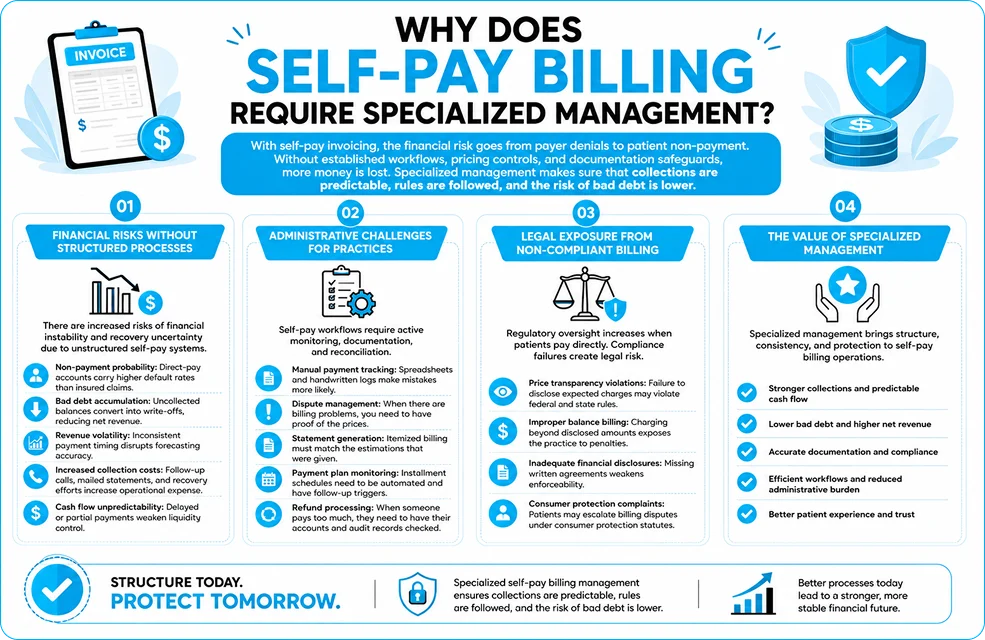
With self-pay invoicing, the financial risk goes from payer denials to patient non-payment. Without established workflows, pricing controls, and documentation safeguards, more money is lost. Specialized management makes sure that collections are predictable, rules are followed, and the risk of bad debt is lower.
Financial Risks Without Structured Processes
There are increased risks of financial instability and recovery uncertainty due to unstructured self-pay systems.
- Non-payment probability: Direct-pay accounts carry higher default rates than insured claims.
- Bad debt accumulation: Uncollected balances convert into write-offs, reducing net revenue.
- Revenue volatility: Inconsistent payment timing disrupts forecasting accuracy.
- Increased collection costs: Follow-up calls, mailed statements, and recovery efforts increase operational expense.
- Cash flow unpredictability: Delayed or partial payments weaken liquidity control.
Administrative Challenges for Practices
Self-pay workflows require active monitoring, documentation, and reconciliation.
- Manual payment tracking: Spreadsheets and handwritten logs make mistakes more likely.
- Dispute management: When there are billing problems, you need to have proof of the prices.
- Statement generation: Itemized billing must match the estimations that were given.
- Payment plan monitoring: Installment schedules need to be automated and have follow-up triggers.
- Refund processing: When someone pays too much, they need to have their accounts and audit records checked.
Legal Exposure From Non-Compliant Billing
Regulatory oversight increases when patients pay directly. Compliance failures create legal risk.
- Price transparency violations: Failure to disclose expected charges may violate federal and state rules.
- Improper balance billing: Charging beyond disclosed amounts exposes the practice to penalties.
- Inadequate financial disclosures: Missing written agreements weakens enforceability.
- Consumer protection complaints: Patients may escalate billing disputes under consumer protection statutes.
Federal Rules Governing Self-Pay Patients in the United States
Federal regulations allow pricing transparency, patient protection, and emergency care obligations for uninsured and self-pay individuals. Providers must integrate these requirements into intake, estimation, and billing workflows to avoid penalties and enforcement actions.
No Surprises Act Requirements
The No Surprises Act protects those who don’t have insurance or who pay for their own care from getting charged too much or unexpectedly for medical care. Providers must make sure that the final billed amounts do not go over the Good Faith Estimate that was given. Patients have the right to start an independent dispute resolution process if the billed charges are far higher than the estimate. Structured paperwork and accurate estimates lower the risk of disagreements.
Good Faith Estimate (GFE) Obligations
Before scheduling services, providers must give uninsured or self-pay patients a Good Faith Estimate (GFE). The estimate must list the predicted costs for each service and procedure that is intended to be done.
The timeline requirements depend on how far in advance the service is planned. When you make an appointment on short notice, you need the estimate faster. For compliance and audit purposes, providers must keep records of the GFE and all related conversations.
CMS Price Transparency Regulations
Hospitals must post their regular costs for services publicly because of CMS price transparency rules. Consumers need to be able to easily find and understand pricing information so they can look over predicted expenses and make smart financial choices before getting treatment.
EMTALA Restrictions for Emergency Care
The Emergency Medical Treatment and Labor Act (EMTALA) prohibits delaying emergency treatment to request payment. Medical screening and stabilization must occur before financial discussions. Self-pay status does not override emergency care obligations. Financial conversations may begin only after the patient is medically stable.
State Regulations and Consumer Protection Considerations
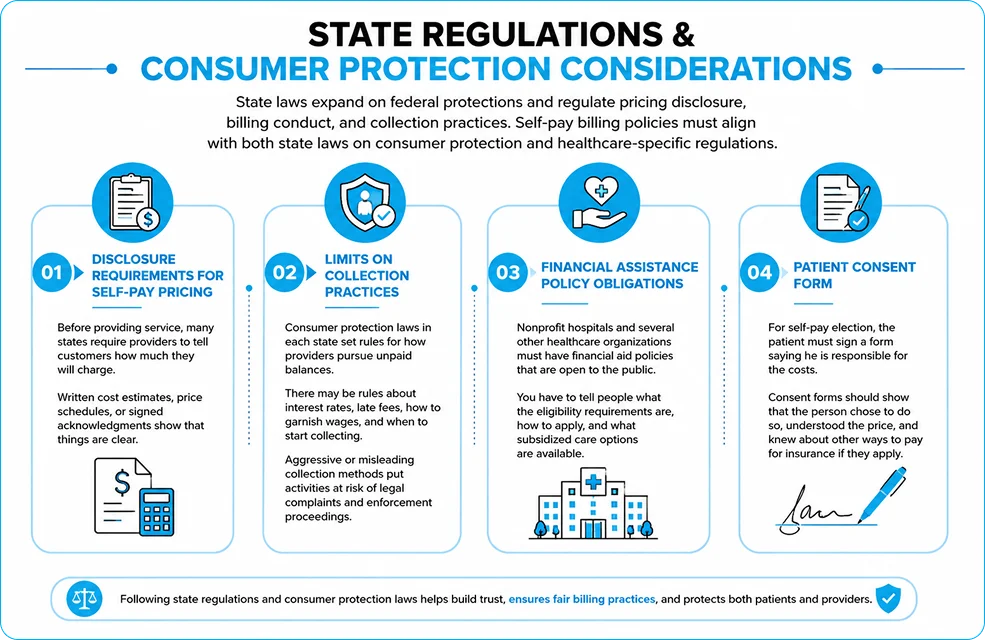
State laws expand on federal protections and regulate pricing disclosure, billing conduct, and collection practices. Self-pay billing policies must align with both state laws on consumer protection and healthcare-specific regulations.
Disclosure Requirements for Self-Pay Pricing
Before providing service, many states require providers to tell customers how much they will charge. Written cost estimates, price schedules, or signed acknowledgments show that things are clear.
Limits on Collection Practices
Consumer protection laws in each state set rules for how providers pursue unpaid balances. There may be rules about interest rates, late fees, how to garnish wages, and when to start collecting. Aggressive or misleading collection methods put activities at risk of legal complaints and enforcement proceedings.
Financial Assistance Policy Obligations
Nonprofit hospitals and several other healthcare organizations must have financial aid policies that are open to the public. You have to tell people what the eligibility requirements are, how to apply, and what subsidized care options are available.
Patient Consent form
For self-pay election, the patient must sign a form saying he is responsible for the costs. Consent forms should show that the person chose to do so, understood the price, and knew about other ways to pay for insurance if they apply.
The Complete Self-Pay Billing Workflow
For self-pay billing to succeed, there needs to be a clear process from intake to final collection. Each stage needs to keep track of prices, make sure they are financially responsible, and keep an eye on revenue risk.
Patient Intake and Insurance Status Verification
The first step in the workflow is to check the patient’s insurance status and write down their self-pay classification.
- Confirmation of coverage: checking to see if you are eligible for active insurance.
- Self-pay designation documents: the account that was set up as self-pay before the service was provided.
- Acknowledgment of financial responsibility: a signed document from the patient that says they are fully responsible for paying.
Cost Estimation and Financial Counseling
Before services are provided, there must be cost transparency. Financial advice makes sure that patients know what charges to expect.
- Review of procedure pricing: Staff look over CPT-based pricing and services that are expected.
- Calculating out-of-pocket costs: The total amount predicted to be spent is figured up and written down.
- Talk about payment alternatives: There are options for deposits, payment plans, or loans.
Upfront Payment Collection or Deposit
Pre-service collection reduces non-payment risk and stabilizes cash flow.
- Pre-service full payment: Full payment is collected before the appointment.
- Percentage deposits: A defined portion of the estimated charge is collected.
- Credit card on file authorization: Stored payment authorization supports balance capture after reconciliation.
Service Delivery and Charge Finalization
Final billing must reconcile estimated services with actual services rendered.
- Actual services reconciliation: CPT services performed are confirmed and documented.
- Additional charge identification: Ancillary or unexpected services are added to the account.
- Refund or balance calculation: Overpayments are refunded, or remaining balances are billed.
Statement Generation and Follow-Up
Structured follow-up makes sure that payments are made on time and that documents are correct.
- Itemized billing: Bills clearly show the services, dates, and costs.
- Payment reminders: Automated reminders help get more payments.
- The collection escalation procedure moves unpaid accounts through a series of predetermined internal and external recovery stages.
Pricing Strategies for Self-Pay Services
Pricing for self-pay must find a balance between maximizing profits, following the rules, and being competitive in the market. Clear price reasoning cuts down on arguments and makes it easier to collect money up front.
Chargemaster vs Discounted Cash Pricing
Chargemaster rates are the provider’s normal gross charges. Discounted cash pricing means lower administrative costs because there is no need to handle insurance claims. To encourage people to pay right away and limit the risk of bad debt, many practices publish a set self-pay rate that is lower than the chargemaster amount.
Prompt-Pay Discounts and Incentives
Prompt-pay discounts are given for paying right away or on the same day. A set percentage drop encourages full payment in advance. Structured incentives lower the expenses of following up and decrease aging accounts receivable.
Sliding Scale Fees for Financial Accessibility
Prices on a sliding scale change based on proof of income. This methodology makes it easier for people to get money while keeping the integrity of the revenue. Clear qualifying requirements and paperwork stop people from applying in different ways.
Bundled Pricing for Predictability
Bundled pricing means that several related services are offered for a single, set price. A predictable package price decreases the chances of billing disputes and makes it easier to talk about money before service is delivered.
Market-Based Competitive Prog Models
Market-based pricing aligns self-pay rates with regional competitors and specialty benchmarks. Competitive positioning increases patient retention and reduces pricing-related complaints.
What Are Common Benchmarks for Self-Pay Patients?
Healthcare organizations often track performance indicators for self-pay accounts, including:
| Benchmark | Common Goal |
| Upfront Collection Rate | 70–90%+ |
| Self-Pay Days in A/R | Under 30 Days |
| Bad Debt Percentage | Below 5–10% |
| Payment Plan Completion Rate | Above 80% |
| Collection Rate on Self-Pay Balances | Above 85% |
Benchmark targets vary by specialty, service mix, and patient demographics.
Payment Collection Methods That Improve Recovery Rates
Structured payment systems reduce default probability and improve cash realization from direct-pay accounts.
Pre-Service Collection Best Practices
Collection before service delivery significantly lowers non-payment risk. Verified estimates, signed financial agreements, and defined deposit policies improve compliance.
Automated Payment Plans
Automated installment plans divide balances into scheduled payments. Recurring charges reduce manual tracking and improve payment consistency.
Credit Card on File (CCOF) Policies
Credit Card on File (CCOF) authorization allows providers to charge remaining balances after service reconciliation. Documented consent protects compliance and reduces recovery delays.
Online Payment Portals and Digital Billing
Digital payment platforms enable secure online transactions. Automated reminders and electronic statements speed up the time it takes to pay.
Patient Financing and Healthcare Lending Options
Third-party financing allows payment over time for higher-value procedures. Structured loan solutions make it easier for people to accept services while keeping providers’ cash flow stable.
Managing Risk of Non-Payment and Bad Debt
Self-pay billing replaces denial risk with non-payment risk. Structured financial controls lower risk and keep revenue safe. Clear rules make things more predictable and lower the number of write-offs.
Financial Screening Procedures
Before giving a patient service, financial screening checks to see if they can pay. When deciding how much to put down, we look at things including income verification, past payment history, and the cost of the service. Early screening cuts down on accounts that are at high risk.
Deposit Requirements Based on Service Cost
The value of the procedure should match the deposit policy. To avoid risk, services that cost more upfront need to be paid for in full. Defined deposit criteria improve collection efficiency and keep balances from getting older.
Internal Collection Strategies
Structured follow-up inside the organization raises recovery rates. Timely reminders, set call schedules, and written payment plan reviews stop accounts from becoming bad debt.
External Collection Agency Coordination
Accounts that are older than a certain amount of time may be sent to outside recovery partners. Clear handoff protocols, paperwork records, and compliance reviews keep customers from complaining about the practice.
Write-Off Policies and Accounting Treatment
Formal policies for writing off debts make sure that financial reports are correct. The paperwork must back up the classification of bad debts, the adjustment entries, and the compliance check. Controlled write-offs stop revenue reporting from becoming unreliable.
Documentation Required for Compliant Self-Pay Billing
Self-pay billing depends on enforceable documentation. Written agreements protect compliance and reduce dispute risk.
Financial Responsibility Agreement
A signed financial responsibility agreement confirms the patient’s obligation to pay the full charge. The agreement should outline pricing structure, deposit terms, and payment timelines.
Informed Consent for Self-Pay Election
Patients must agree that they chose to pay for their own care. If applicable, documents should show that the person is aware of their insurance alternatives.
Good Faith Estimate Documentation
Providers must keep copies of all Good Faith Estimates and any other correspondence that goes with them.
Payment Authorization Forms
Before charging stored payment methods, you must have written proof of credit card authorization or permission for recurring payments. Getting the right permission eliminates charge disputes.
Refund and Adjustment Records
Refunds and price changes need detailed logs. Accurate records help with being ready for an audit and being open about money.
Self-Pay vs Insurance Billing: Revenue Cycle Comparison
There are numerous ways that self-pay and insurance billing work in terms of the revenue cycle. One depends on the patient’s ability to accelerate revenue generation. The other relies on how the payer decides how much is authorized and the reimbursement timelines.
Speed of Revenue Recognition
| Factor | Self-Pay Billing | Insurance Billing |
| Revenue Timing | Collected and recognized at or before time of service | Recognized after claim adjudication and payment posting |
| Required Steps | Payment collection only | Claim submission → Payer review → Remittance processing → Posting |
| Payment Delay | Minimal | Dependent on payer processing cycle |
| Cash Flow Impact | Immediate liquidity | Delayed reimbursement |
Administrative Cost Differences
| Factor | Self-Pay Billing | Insurance Billing |
| Coding Requirement | Limited to internal pricing reference | Full CPT/ICD coding required |
| Clearinghouse Submission | Not required | Required for claim transmission |
| Denial Management | Not applicable | Required for rejected or denied claims |
| Appeals Process | Not required | Required for disputed claims |
| Primary Administrative Focus | Pricing transparency and collection control | Claims management and reimbursement follow-up |
Denial Risk vs Non-Payment Risk
| Factor | Insurance Billing | Self-Pay Billing |
| Primary Risk Type | Claim denial by payer | Patient non-payment |
| Cause of Revenue Loss | Medical necessity issues, coding errors, authorization failures | Inability or refusal to pay |
| Who Controls Outcome | Payer adjudication rules | Provider’s financial policies |
| Recovery Method | Appeals and resubmissions | Payment plans and collections |
| Predictability | Dependent on payer processing | Dependent on patient payment behavior |
| Risk Mitigation Strategy | Accurate coding and authorization management | Upfront collection and deposit policies |
Key Distinction:
- Insurance billing risk is administrative and payer-driven.
- Self-pay risk is financial and patient-driven.
Structured workflows reduce exposure in both models.
Cash Flow Predictability
| Factor | Self-Pay Billing | Insurance Billing |
| Payment Timing | Collected before or at time of service | Paid after adjudication cycle |
| Forecasting Accuracy | High when deposits are required | Variable based on payer timelines |
| Revenue Stability | Controlled by internal collection policy | Influenced by payer processing delays |
| Liquidity Impact | Immediate cash inflow | Delayed reimbursement inflow |
Operational Complexity
| Factor | Self-Pay Billing | Insurance Billing |
| Workflow Steps | Estimate → Agreement → Collection → Follow-up | Coding → Claim edits → Submission → Adjudication → Posting → Appeals |
| External Dependency | Minimal | High payer dependency |
| Documentation Focus | Pricing disclosure and consent | Medical necessity and coding compliance |
| Process Management | Collection monitoring | Denial management and payer communication |
Provider Types That Commonly Use Self-Pay Models
Self-pay models are common in specialties where elective services, privacy considerations, or membership structures reduce dependence on insurance reimbursement.
| Provider Type | Why Self-Pay Is Used | Revenue Structure |
| Private Medical Practices | Reduce administrative overhead and payer dependency | Direct service-based payment |
| Mental Health and Therapy Providers | Protect privacy and simplify billing workflows | Session-based direct payment |
| Telehealth Services | Integrate digital payment systems into virtual care | Online pre-service payment |
| Cosmetic and Elective Procedure Clinics | Services often not covered by insurance | Pre-service full payment |
| Direct Primary Care and Concierge Medicine | Operate outside traditional insurance contracts | Recurring membership fees |
What Technology Solutions Support Modern Self-Pay Billing?
Modern self-pay billing relies on automation, documentation control, and real-time visibility to reduce errors and improve recovery rates.
| Technology Type | Core Function | Financial Impact |
| Practice Management Systems | Track demographics, self-pay status, estimates, deposits, balances | Prevent claim errors and improve balance accuracy |
| Automated Billing Platforms | Generate statements, apply deposits, trigger reminders | Shorten collection cycles |
| Payment Tracking Software | Monitor payment plans, aging, refunds | Reduce bad debt exposure |
| Patient Communication Tools | Send reminders via SMS, email, portals | Improve payment compliance |
| Reporting and Analytics Dashboards | Measure collection rate, payment time, write-offs | Strengthen financial control |
Clear system integration improves efficiency and revenue predictability.
How Outsourced Self-Pay Billing Services Improve Financial Performance
Outsourced self-pay billing services use standardized procedures, compliance checks, and structured follow-up systems. Specialized management makes revenue more stable and lowers risk.
Standardized Intake and Pricing Processes
Outsourcing partners use the same forms for intake, delivery estimates, and deposits. Standardization makes things more consistent and stops price disagreements.
Compliance Monitoring and Documentation Control
Dedicated billing teams keep an eye on compliance with Good Faith Estimates, consent forms, and pricing disclosures. Controlled documentation lowers the risk of being in trouble with the law.
Higher Collection Rates Through Structured Follow-Up
Compared to unstructured internal processes, systematic reminder schedules, installment tracking, and escalation rules lead to higher recovery rates.
Reduced Administrative Burden for Staff
Billing professionals handle pricing, agreements, and collections, while clinical and front-desk staff focus on patient care.
Predictable Revenue From Cash-Pay Patients
Structured outsourcing turns self-pay accounts into steady sources of income. Consistent processes make it easier to estimate cash flow and make bad debt less likely to happen.
Why Choose Avenue Billing Services for Self-Pay Billing Management
Self-pay billing requires regulatory alignment, structured intake, and disciplined collection systems. Avenue Billing Services implements standardized workflows that protect compliance while improving cash realization from direct-pay patients.
Nationwide Expertise in U.S. Healthcare Regulations
Our team aligns self-pay workflows with federal rules, including Good Faith Estimate requirements and price transparency standards. Multi-state regulatory awareness reduces exposure to consumer protection violations.
Transparent Pricing Implementation Support
We assist practices in establishing documented fee schedules, discount policies, and deposit structures. Clear pricing frameworks reduce disputes and improve upfront collection confidence.
Advanced Payment Collection Systems
Automated reminders, tracking payments, and Credit Card on File (CCOF) controls all help recovery rates. Structured escalation mechanisms help lower old balances.
Dedicated Financial Counseling Workflows
Standardized financial counseling scripts make sure that patients know how much they will have to pay, when they will have to pay it, and what other financing options are available before they get the service.
Proven Revenue Optimization Strategies
Data-driven reporting keeps track of the upfront collection rate, the percentage of bad debt, and the typical payment duration. Measurable performance indicators make it easier to anticipate revenue.
Who We Serve
Avenue Billing Services supports healthcare organizations that manage direct-pay and uninsured patient populations.
- Physicians and specialty clinics
- Behavioral health practices
- Urgent care centers
- Telemedicine providers
- Surgery centers
- Out-of-network providers
Expected Outcomes From Professional Self-Pay Billing Management
Structured self-pay management produces measurable financial improvements.
- Increased upfront collections
- Reduced bad debt and write-offs
- Improved patient payment compliance
- Stronger cash flow stability
- Lower administrative costs
Conclusion: Get Expert Self-Pay Billing Support for Your Practice
Self-pay patients represent both opportunity and financial risk. Structured billing systems ensure compliance, transparency, and consistent revenue while protecting patient relationships. Professional management transforms direct-pay services into a reliable component of your revenue cycle.
Call to Action: Request a consultation/audit.
FAQ
Is it legal to self-pay while you have insurance?
Yes. Patients can opt for self-pay, particularly for privacy or non-covered services. In many situations, patients may choose to self-pay even when they have active insurance coverage. This occurs when patients want greater privacy, are seeking non-covered services, or prefer a discounted cash rate. Providers should document the patient’s decision and obtain written acknowledgement of financial responsibility.
Is a good faith estimate mandatory for self-pay patients?
Federal regulations require a Good Faith Estimate before scheduled services for uninsured or self-pay individuals.
What happens if a self-pay patient cannot pay after treatment?
Balances may move into payment plans, internal collections, or external recovery depending on provider policy.
Are self-pay prices lower than insurance rates?
Cash pricing often reflects reduced administrative overhead compared to insurance billing.
Can self-pay services later be billed to insurance?
Retroactive billing may occur if eligibility is established, subject to payer requirements.
What Is Self-Pay Insurance?
Self-pay insurance is not a formal insurance product. The term is used when patients pay directly for healthcare services rather than submitting claims to an insurance company.
What Is a Self-Payor in Healthcare?
A self-payor is an individual who pays healthcare expenses out of pocket without relying on insurance reimbursement. The self-payor may be uninsured, underinsured, or voluntarily choosing not to use available insurance benefits.
What Are the Rules for Charging Self-Pay Patients?
Providers must comply with federal and state regulations when charging self-pay patients. Key requirements include providing accurate price disclosures, issuing Good Faith Estimates when required, maintaining transparent billing practices, obtaining patient consent, and avoiding misleading collection activities.
How Do Self-Pay Fee Schedules Compare to Insurance Fee Schedules?
Self-pay fee schedules are established directly by the provider and often include discounted cash rates. Insurance fee schedules are negotiated reimbursement rates established through payer contracts. Self-pay pricing may be higher or lower than insurance reimbursement depending on the provider’s pricing strategy and market conditions.
What Does Reduction in Self-Pay Days Mean?
Reduction in self-pay days refers to decreasing the average number of days it takes to collect payment from self-pay patients. Lower self-pay days generally indicate stronger collection processes, improved cash flow, and reduced bad debt exposure.
What Is a Default Self-Pay Refund Debit?
A default self-pay refund debit is an accounting adjustment used when a self-pay patient has an overpayment that must be refunded. The debit entry records the reduction of the organization’s liability while maintaining an accurate audit trail for financial reconciliation.
What Are Self-Pay Services?
Self-pay services are healthcare services paid directly by the patient without insurance involvement. Examples include cosmetic procedures, direct primary care memberships, wellness services, certain behavioral health treatments, elective procedures, and services excluded from insurance coverage.
Which of the Following Is Not a Factor in Self-Pay Follow-Up?
Common self-pay follow-up factors include account balance, payment history, financial hardship status, aging category, and communication history. Clinical diagnosis alone is generally not a primary factor in collection follow-up decisions unless it directly affects financial assistance eligibility or payment arrangements.