

Billing teams treat diagnostic laparoscopy as “simple.” Claim outcomes prove the opposite. CPT 49320 sits inside a set of coding rules that reward precision and punish assumptions. A clean claim needs 3 aligned pieces: intent, operative facts, and modifier logic.
CPT content is copyrighted by the AMA. This article paraphrases public-facing descriptors and payer policy guidance rather than reproducing proprietary CPT text.
What CPT 49320 describes
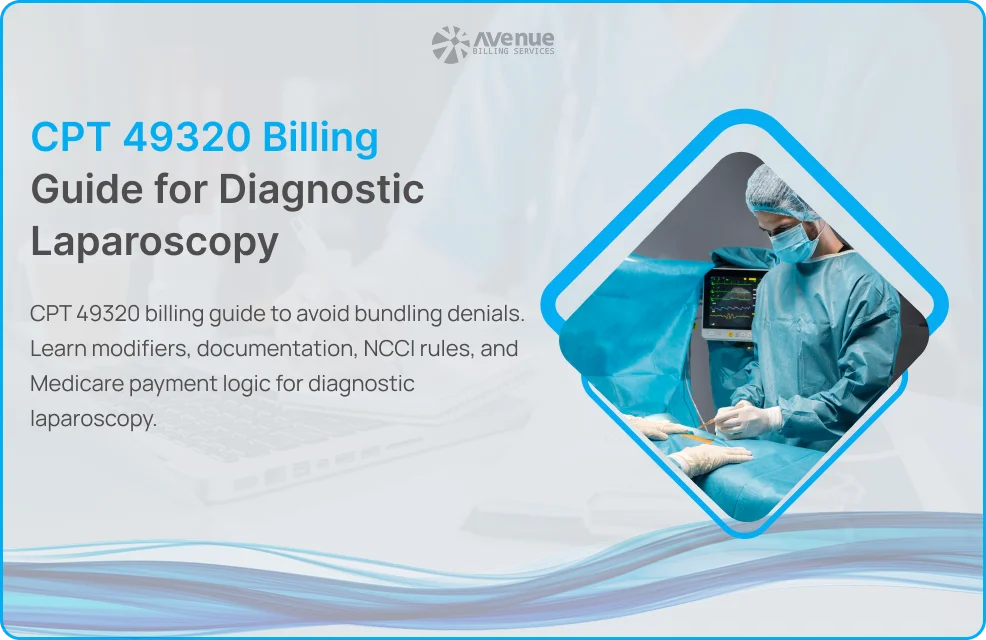
CPT 49320 reports diagnostic laparoscopy of the abdomen, peritoneum, and omentum, with or without specimen collection by brushing or washing, and carries the label “separate procedure.”
Clinical work for 49320 centers on inspection. The surgeon introduces a laparoscope through small abdominal incisions and evaluates peritoneal surfaces and abdominal organs. Washings or brushings may occur during the same session and remain included in the code descriptor.
The “separate procedure” label changes how payers treat the code. Separate-procedure services are commonly considered incidental when performed as part of a broader operation in the same anatomic region. The code becomes vulnerable to bundling edits unless documentation supports a distinct service scenario.
Clinical intent that supports CPT 49320
Diagnostic laparoscopy answers a question that noninvasive testing did not answer. A claim reads stronger when the record states the exact question.
Common diagnostic questions include:
- Unexplained abdominal pain after nondiagnostic imaging
- Suspected malignancy requiring direct visualization for staging decisions
- Ascites evaluation when etiology remains unclear after workup
- Adhesion assessment in patients with prior surgery and persistent symptoms
- Pelvic pain and infertility assessment with suspected endometriosis or peritoneal disease
Payers do not reimburse “curiosity.” Medical necessity rests on a documented diagnostic problem, and a reason imaging or prior testing did not resolve it.
Diagnostic laparoscopy vs therapeutic laparoscopy
CPT 49320 applies to diagnostic-only work. Therapeutic action shifts reporting to a surgical laparoscopy code that describes the performed intervention.
Coding changes at the first therapeutic step, such as:
- Biopsy
- Aspiration or drainage
- Lysis of adhesions
- Excision, ablation, or removal of tissue/lesions
- Repair of a structure
A frequent error appears in operative reports that describe a diagnostic survey followed by treatment, then attempt to report both the treatment code and 49320. Many payer systems treat diagnostic laparoscopy as bundled into the definitive service in that same session, especially when the diagnostic portion formed the basis for the therapeutic decision. CMS NCCI policy describes this diagnostic-to-therapeutic sequence as a classic bundling scenario.
“Separate procedure” status and what bundling means
The CPT label “separate procedure” signals that the service is commonly a component of a more comprehensive service in the same operative field. CPT 49320 includes that label in the descriptor.
Separate reporting becomes reasonable under a narrow set of circumstances, such as:
- Different operative sessions on the same date
- Different anatomic site/region from the primary procedure
- Distinct diagnostic purpose not inherent to the primary procedure
- Independent decision-making is documented as distinct from the therapeutic plan
Distinctness must exist in facts, not in narrative tone.
A coding decision path for CPT 49320
Use this 6-step decision path during coding review:
- Primary intent stated in the pre-op note as diagnostic evaluation of abdomen/peritoneum/omentum
- Operative report documents the survey of the listed inspected structures
- No therapeutic service performed beyond brushing/washing
- No conversion to another laparoscopic or open procedure that includes exploration as a standard component
- No NCCI or payer bundling rule blocks separate payment without an allowed modifier
- Claim modifiers match the distinctness scenario, and the record supports the modifier criteria
Step 3 eliminates many disputes. Brushing and washing remain included in 49320 and do not convert the service into a biopsy code.
Modifier strategy that survives payer review
Modifier use should follow payer logic, not habit. CMS states that NCCI-associated modifiers must meet their criteria, and documentation must support the criteria used.
Modifier 59 and the X{EPSU} modifiers (XE, XS, XP, XU)
Modifier 59 indicates a distinct procedural service. CMS recognizes 59 and the more specific subset modifiers:
- XE Separate encounter
- XS Separate structure
- XP Separate practitioner
- XU Unusual non-overlapping service
CMS guidance encourages selecting the most specific modifier that describes the distinctness scenario and limiting 59 to cases where no other modifier fits.
Claims involving CPT 49320 most often rely on XS (separate structure) or XE (separate encounter). The record must describe the separate site or the separate encounter clearly.
Distinctness does not come from a different ICD-10 code alone. CMS NCCI policy states that different diagnoses do not unbundle code pairs by themselves.
Modifier 51 for multiple procedures
Modifier 51 signals multiple procedures in the same session. Many payers apply multiple-procedure pricing automatically and do not require 51. Some commercial payers still accept 51 as sequencing support. Payer policy determines whether the modifier belongs on the claim.
A billing rule matters here: modifier 51 does not solve a bundling edit. NCCI distinctness modifiers handle bundling logic.
Modifier 52 for reduced services
Modifier 52 reports a reduced service. CPT 49320 with modifier 52 fits scenarios where the laparoscopic survey could not be completed as intended, yet enough diagnostic work occurred to justify partial reporting.
Clinical examples include:
- Extensive adhesions prevent adequate visualization
- Inability to insufflate safely
- Limited inspection due to anatomical constraints documented intraoperatively
Operative notes should specify what portion of the diagnostic survey occurred and what blocked completion.
Modifier 53 for discontinued procedure
Modifier 53 applies to a procedure started and stopped due to extenuating circumstances or patient safety concerns. Documentation should include:
- Stop time or approximate point of discontinuation
- Clinical trigger, such as hemodynamic instability
- Services performed up to discontinuation
Assistant surgeon modifiers (80, 81, 82) and modifier AS
Assistant surgeon reporting depends on payer credentialing rules and medical necessity. Claims need documentation that supports the assistant’s role. Modifier AS applies to qualified non-physician assistants when permitted by the payer.
Documentation standards that reduce denials
A payer cannot “see” your intent. The operative report supplies proof. A denial-proof report for CPT 49320 contains 9 elements.
The 9 elements to include in the op note
- Pre-op diagnosis stated as the diagnostic problem
- Post-op diagnosis stated as findings-based conclusion or “no abnormal findings.”
- Indication stating the unanswered clinical question and why laparoscopy was selected
- Extent of inspection listing surveyed structures (examples: liver surface, stomach, small bowel, colon, appendix, peritoneal surfaces, omentum)
- Findings stated in objective terms, including negative findings
- Specimen handling, documenting brushings/washings when performed
- Decision impact stating whether findings changed the plan (examples: aborted planned resection, staged later surgery, referred to oncology)
- No therapeutic intervention statement when appropriate
- Complications and limitations documenting barriers to visualization for 52/53 use
Element 8 prevents a common payer assumption that the laparoscopy served as a routine exploration for another procedure.
Specimen collection: brushing and washing
Brushing and washing are included in CPT 49320 per the descriptor language. Separate billing for that collection invites overcoding denials.
Pathology billing follows its own rules. A cytology or pathology interpretation code may apply for the lab component under the appropriate billing entity and payer policy, yet the collection remains included in 49320.
Medicare reimbursement: how payment gets set
Medicare physician payment uses the Physician Fee Schedule (PFS). CMS publishes annual updates and makes pricing, RVUs, and payment indicators available through the PFS Look-Up Tool.
Two Medicare concepts shape expected reimbursement workflow:
Facility vs non-facility payment
Medicare often pays different amounts for the same CPT code based on place of service. A hospital outpatient department or ASC counts as a facility. A physician’s office setting counts as a non-facility. Diagnostic laparoscopy typically occurs in a facility setting, so facility pricing often applies.
CMS finalized multiple PFS policy changes for CY 2026, and the PFS final rule summary remains the authoritative source for current-year policy framing.
Global surgical package and global days
Global periods affect post-op visit billing and related claim edits. Public payer resources list CPT 49320 with a 10-day global period in common global-day references.
Medicare global surgery policy states that post-operative visits within the global period are packaged into payment for many procedures.
NCCI, MACs, and why local rules still matter
NCCI edits influence whether Medicare pays two procedure codes together on the same date of service. CMS publishes NCCI policy manuals and modifier guidance that MAC systems use during claims processing.
Medicare Administrative Contractors (MACs) administer claims and apply national policy plus local coverage rules. Local Coverage Determinations (LCDs) may shape documentation expectations for certain indications or associated testing.
A practical takeaway: coding logic should align with NCCI policy first, then payer contracts, then local MAC articles.
The 7 most common CPT 49320 denial triggers
- Diagnostic survey performed before a therapeutic procedure in the same session, then billed separately
- Modifier 59 appended without a distinctness fact pattern supported in the op note
- The separate-procedure label was ignored and billed alongside a more comprehensive abdominal/pelvic surgery with no separate indication
- Operative report lacks inspected-structure detail, so the payer treats the service as a routine look
- Specimen collection is billed separately, even though 49320 includes washing/brushing collection
- Incorrect discontinued/reduced modifier selection with no stop reason or incomplete service description
- Diagnosis mismatch between the clinical question and the submitted ICD-10 code set, weakening medical necessity
CMS NCCI policy highlights the misuse of modifier 59 and states that documentation must meet the criteria for any NCCI-associated modifier used.
CPT 49320 compared with nearby codes
CPT 49320 vs CPT 49321 (biopsy)
CPT 49321 applies to laparoscopy with biopsy. Tissue sampling changes the procedure category from diagnostic survey to surgical laparoscopy with biopsy. Teams should code the biopsy service when performed, rather than reporting 49320.
CPT 49320 vs CPT 49322 (aspiration)
CPT 49322 describes aspiration of a cavity or cyst by laparoscopy. Fluid aspiration moves the service into a therapeutic intervention code set.
CPT 49320 vs CPT 49000 (open exploration)
CPT 49000 describes open exploratory surgery of the abdomen. CPT 49320 describes laparoscopic exploration and diagnostic visualization. The approach and typical recovery differ, and the code families differ accordingly.
ICD-10 linkage: diagnosis selection that supports medical necessity
ICD-10 codes tied to 49320 should reflect the diagnostic problem. Common categories include:
- Abdominal pain syndromes
- Ascites and peritoneal fluid disorders
- Suspected intra-abdominal malignancy or metastatic disease workup
- Peritoneal disorders
- Infertility-related pelvic pain conditions under payer policy
A defensible claim shows alignment between:
- Ordering workup and imaging results
- Pre-op diagnosis
- Indication statement
- Procedure performed
- Findings and post-op diagnosis
Real-world billing scenarios
Scenario 1: Diagnostic-only laparoscopy, no additional procedure
Clinical facts: Persistent abdominal pain, imaging nondiagnostic. Surgeon performs a full diagnostic survey. No biopsy, no lysis, no aspiration.
Coding outcome: CPT 49320 alone. No modifier required under standard circumstances.
Documentation cue: A single sentence stating “No therapeutic intervention performed” reduces payer assumptions.
Scenario 2: Diagnostic survey leads directly to treatment in the same session
Clinical facts: The surgeon begins with a diagnostic survey. Findings show endometriosis lesions. Surgeon excises or ablates lesions during the same operative session.
Coding outcome: Report the definitive therapeutic laparoscopy code. Diagnostic laparoscopy becomes bundled in many payer systems, especially when the diagnostic work served as the basis for the treatment decision. CMS NCCI policy describes this diagnostic-to-therapeutic pathway as a common bundling concept.
Documentation cue: The op note should still document the diagnostic survey, yet billing should focus on the performed therapeutic service.
Scenario 3: Discontinued diagnostic laparoscopy due to patient instability
Clinical facts: Procedure begins. Hemodynamic instability develops after insufflation. Surgeon stops the procedure.
Coding outcome: CPT 49320-53 with a clearly documented reason for discontinuation and what was completed before stopping.
Documentation cue: Include objective vitals trend or anesthesiology note reference, and the exact point of termination.
A claim-ready checklist for CPT 49320
Use this checklist before claim submission:
- Indication supports medical necessity and matches ICD-10
- Op note lists inspected structures and findings
- Statement clarifies diagnostic-only intent when no therapeutic work occurred
- Washing/brushing is documented without separate collection billing
- Modifier 52 or 53 supported by explicit limitation/stop reason
- Modifier 59 or X{EPSU} used only with a documented distinctness scenario consistent with CMS guidance
- PFS pricing and indicators verified through the CMS PFS Look-Up Tool for the service year
Conclusion
CPT 49320 represents diagnostic laparoscopic evaluation, yet payer systems treat it as a high-scrutiny code due to its “separate procedure” status. Clean reimbursement depends on documented diagnostic intent, a detailed survey narrative, and modifier use that matches CMS NCCI criteria. CMS policy places responsibility on the provider record to justify any NCCI-associated modifier appended to bypass an edit.
A workflow that couples a structured op note with a pre-submission checklist turns CPT 49320 into a predictable claim rather than a denial pattern.
FAQ on CPT 49320
What does CPT 49320 report?
CPT 49320 reports diagnostic laparoscopy of the abdomen, peritoneum, and omentum, with or without specimen collection by brushing or washing, and it is labeled as a separate procedure.
Does CPT 49320 require a modifier?
Modifier use depends on context. Standalone diagnostic laparoscopy often needs no modifier. Distinctness scenarios require an appropriate NCCI-associated modifier supported by documentation.
Can CPT 49320 be billed with another laparoscopic procedure?
Separate reporting faces bundling risk due to the “separate procedure” label. Separate reporting requires a distinct scenario supported by documentation and allowed by the payer’s edit logic.
Are brushings and washings billed separately?
Collection by brushing or washing is included in the CPT 49320 descriptor. Separate billing for collection commonly creates denials.
Does Medicare reimburse CPT 49320?
Medicare reimburses covered services per the Physician Fee Schedule. Payment details vary by year, locality, and place of service, and CMS provides the PFS Look-Up Tool for pricing and RVU indicators.