




GO BACK

ICD-10 refers to the International Classification of Diseases, 10th Revision. Doctors and nurses often use this method to group medical conditions and treatments. This coding system makes it easier to correctly sort diagnoses, write clinical notes, and charge for medical services. Each code is very important for figuring out how to pay for medical diagnoses. It is very important to write down injuries in ICD-10 because it shows how bad the injury is and where it happened.
In dog bite cases, injuries must be classified correctly so that patients can get the best care, and the right amount of money can be paid back. Healthcare professionals use standardized coding and billing to keep accurate records, improve patient outcomes, and help with research and statistical analysis in the healthcare field.
What is ICD-10?
The ICD-10 medical coding system is always changing to make sure that health records are correct. A lot more diagnosis and procedure codes have been added since the US healthcare system switched from ICD-9 to ICD-10 in 2015. These changes make it easier to remember where the body is, what caused the injury, and how bad the illness is.
The 2026 ICD-10 updates are all about being more precise, keeping better track of information, and making medical histories easier to understand. Changes to how medical coding and billing work are meant to make documentation and healthcare data analytics even better.
Accurate coding is critical, as these ICD-10 revisions directly affect reimbursement and compliance.
ICD-10 External Cause Codes for Animal-Related Injuries
External causes of morbidity are used to explain how an injury occurred. Animal-related injuries fall into this category and include dog bite injuries from both nonvenomous animals and venomous animals. These codes document exposure to animate mechanical forces and help explain the injury mechanism and injury origin.
ICD-10 W-codes play a key role in the coding hierarchy and classification of animal injuries. They support clinical documentation, injury surveillance, and statistical injury tracking. Healthcare research depends on this data to analyze trends and improve patient safety.
What Is W54.0XXA?
The ICD-10 code for dog bite injuries that happen during a first encounter is W54.0XXA. This part explains what the code means, how it works, and when it should be used in real-life medical situations.
What does the code mean?
The ICD-10 code W54.0XXA means “bitten by dog, first time.” You can bill for healthcare diagnosis reimbursement with this ICD-10 code. After the switch to ICD-10, this code took the place of the ICD-9 code E906.0.
When medical documentation backs it up, the billable status means it can be reported on claims. It falls under exposure to animate mechanical forces and is used to describe the injury encountered during the initial treatment visit. Correct medical classification makes sure that billing and payment are done correctly.
Dog Bite ICD 10
Dog bite ICD-10 coding helps healthcare providers document animal-related injuries accurately for treatment, reporting, and reimbursement. The W54 category identifies injuries caused by dog bites and supports proper clinical documentation, injury classification, and medical billing workflows.
Infection Risk After a Dog Bite
Dog bite injuries carry a high risk of bacterial infection because animal saliva can transfer harmful microorganisms into soft tissue and open wounds. Deep puncture wounds, hand injuries, delayed treatment, and poor wound cleaning increase the risk of cellulitis, abscess formation, and tissue damage. Healthcare providers often evaluate tetanus immunization status, rabies exposure risk, and wound contamination during clinical assessment. Accurate documentation of infection risk supports proper ICD-10 coding, treatment planning, and medical necessity reporting.
W54.0 Explained
W54 is the external cause code category for dog bite injury. The code structure includes body part specificity, such as right hand, left hand, face, right leg, and left leg. It also includes encounter characters like initial encounter, subsequent encounter, and sequela.
These encounter characters work alongside S codes, which are injury nature codes. This code composition helps with billing, getting paid back, and making sure that the diagnosis and procedure match up. Knowing how ICD-10 is set up can help you avoid making mistakes when coding.
Use Cases
People often go to the emergency department for the first time to get treatment for dog bites, where accurate injury documentation and coding are critical. During visits to a healthcare provider, wound care, infection risk management, and injury severity assessment may all be done.
Follow-up care or treatment of sequelae conditions is often part of later visits. Medical records must clearly show what kind of treatment was given so that accurate reporting and payment can happen.
Coding Scenarios for Dog Bites
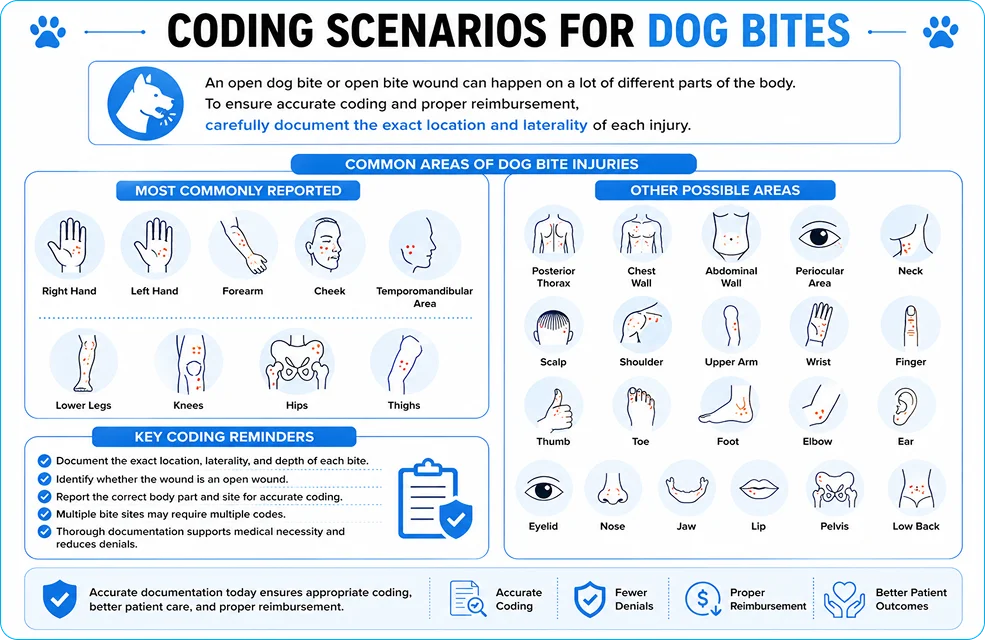
An open dog bite or open bite wound can happen on a lot of different parts of the body. Some common areas of injury are the right hand, left hand, forearm, cheek, and temporomandibular area. People often report injuries to their lower legs, knees, hips, and thighs.
In other cases, injuries to the posterior thorax, chest wall, abdominal wall, periocular area, neck, scalp, shoulder, upper arm, wrist, finger, thumb, toe, foot, elbow, ear, eyelid, nose, jaw, lip, pelvis, and low back are possible. To make sure that coding is correct, each location needs to be carefully documented.
Dog Bite ICD Coding With Respect to Body Parts
Dog bite ICD coding changes according to the injured body part, laterality, wound type, and encounter status. The dog bite itself is not enough for clean coding. The claim should show the actual injury first, such as an open bite of the right hand, left forearm, thigh, or lower leg. The external cause code W54.0XXA, “bitten by dog, initial encounter,” is added after the injury code to explain how the injury happened. ICD-10-CM official guidance also states that an external cause code should not be reported as the principal or first-listed diagnosis.
For active treatment, most dog bite encounters use the “A” seventh character for initial encounter. Follow-up care after active treatment uses “D”, and long-term effects use “S” for sequela. The provider note should clearly document the exact body part, right or left side, depth of wound, infection status, and whether the wound is open, superficial, puncture-type, or complicated.
| Body Part | ICD-10-CM Code | Code Description |
|---|
| Right hand dog bite | S61.451A | Open bite of right hand, initial encounter |
| Left hand dog bite | S61.452A | Open bite of left hand, initial encounter |
| Left forearm dog bite | S51.852A | Open bite of left forearm, initial encounter |
| Right forearm dog bite | S51.851A | Open bite of right forearm, initial encounter |
| Left thigh dog bite | S71.152A | Open bite, left thigh, initial encounter |
| Right thigh dog bite | S71.151A | Open bite, right thigh, initial encounter |
| Left lower leg dog bite | S81.852A | Open bite, left lower leg, initial encounter |
| Right lower leg dog bite | S81.851A | Open bite, right lower leg, initial encounter |
These body-part codes describe the injury site. W54.0XXA explains the cause: bitten by dog. Hand, forearm, thigh, and lower-leg open bite codes are listed under ICD-10-CM injury categories for open wounds of those regions.
ICD 10 Code for Dog Bite Right Hand
The ICD-10 code for dog bite right hand is S61.451A when the documentation supports an open bite of the right hand during active treatment. This code should be listed before W54.0XXA because the hand wound is the actual diagnosis, while the dog bite code explains the cause.
Right-hand dog bites need careful documentation because hand wounds have higher clinical concern due to tendons, joints, nerves, and infection risk. The note should mention whether the wound involves the palm, dorsum of hand, fingers, puncture injury, crush injury, cellulitis, abscess, or foreign material.
Left Hand Dog Bite ICD 10
The ICD-10 code for left hand dog bite is S61.452A for an open bite of the left hand, initial encounter. Use this code only when the provider clearly documents the left hand as the injured site. If the record says only “hand bite” without laterality, the claim loses specificity and may require an unspecified hand code instead.
For clean billing, the documentation should connect the wound to the dog bite event. A stronger note would say: “Open bite wound of left hand caused by dog bite, initial treatment provided.” That supports both the injury code and the external cause code.
Dog Bite Left Forearm ICD 10
The ICD-10 code for dog bite left forearm is S51.852A when the injury is documented as an open bite of the left forearm during the initial encounter. ICD-10 separates forearm wounds from hand, wrist, elbow, and upper arm wounds, so the provider’s exact anatomic wording matters.
A left forearm dog bite should not be coded as a hand wound, elbow wound, or unspecified arm wound unless the documentation supports that site. For claim accuracy, the note should identify the forearm area, wound type, laterality, and whether infection or deeper tissue involvement is present.
Dog Bite Right Forearm ICD 10
The ICD-10 code for dog bite right forearm is S51.851A for an open bite of the right forearm, initial encounter. This code fits when the bite is located between the elbow and wrist and the provider documents an open bite injury.
Right forearm bites need precise wording because coders must avoid mixing forearm wounds with wrist, hand, or elbow codes. If the bite is near the wrist but documented as forearm, S51.851A fits. If the provider documents wrist or hand involvement, a different code category may be needed.
Left Thigh Dog Bite ICD 10
The ICD-10 code for left thigh dog bite is S71.152A for an open bite of the left thigh, initial encounter. Thigh wounds fall under the hip and thigh injury category, not the lower-leg category.
Documentation should state “left thigh” clearly. Vague phrases like “left leg bite” are weaker because ICD-10 separates thigh, lower leg, ankle, and foot. For billing, the note should also describe wound depth, bleeding, closure, irrigation, antibiotics, tetanus review, and infection status when relevant.
Right Thigh Dog Bite ICD 10
The ICD-10 code for right thigh dog bite is S71.151A when the dog bite caused an open bite wound of the right thigh during active treatment. ICD-10-CM code references describe S71.151A as open bite, right thigh, initial encounter.
This code should be used only when the bite is on the upper leg/thigh area. If the dog bite is on the shin, calf, or lower leg, the correct code comes from the S81 category instead. Small wording changes matter here. “Right thigh” and “right lower leg” are not the same coding location.
Left Lower Leg Dog Bite ICD 10
The ICD-10 code for left lower leg dog bite is S81.852A for an open bite of the left lower leg, initial encounter. This code applies to dog bite wounds involving the left lower leg area, such as the calf or shin, when documented as an open bite.
For cleaner coding, the provider should avoid writing only “left leg dog bite.” “Left lower leg” gives better support for S81.852A. If the wound is actually on the ankle or foot, the coder should move away from S81 and select the more specific ankle or foot wound category.
Dog Bite Right Leg ICD 10
For a dog bite right leg ICD-10 search, the most common specific code is S81.851A when the wound is an open bite of the right lower leg, initial encounter. ICD-10-CM lists S81.851A for open bite of the right lower leg.
The phrase “right leg” is too broad for strong coding. The provider should document whether the bite is on the right thigh, right lower leg, right ankle, or right foot. For example, S71.151A fits the right thigh, while S81.851A fits the right lower leg. That difference protects the claim from site-specific coding errors.
For most dog bite claims, the clean structure is:
Specific injury code first + W54.0XXA second + infection or complication code when documented.
W54.0XXA: Common Coding Mistakes
One big mistake is using the wrong primary diagnosis, which means that W54 is incorrectly reported as the main diagnosis. Another problem is not having enough information about the external cause code or using the wrong encounter character.
Errors in processing claims are common when the paperwork is not complete or the body part is not clearly chosen. Incorrect sequencing and coding mistakes raise the risk of denial of payment and delay payment. These situations are commonly reviewed under ICD-10 related claim denials to correct coding and prevent revenue loss.
CD-10 Codes Related to the W54
The W54 series has a lot of codes that are used at different points in care. W54.0XXD is used when someone is bitten by a dog again. W54.0XXS is for the effects of being bitten by a dog.
W54.1XXA is for the first time someone is hit by a dog, and W54.8XXA is for other times someone comes into contact with a dog. These codes help with classifying animal encounters and coding for follow-up injuries.
Coding Best Practices
Accurate documentation is the foundation of clean claims. Coders must confirm body site identification, injury severity, and encounter type selection for every dog bite case.
External cause reporting must support medical necessity and billing accuracy. Standardized records improve compliance, audit readiness, and healthcare reimbursement optimization.
ICD-10 to CPT Mapping for Dog Bite Encounters
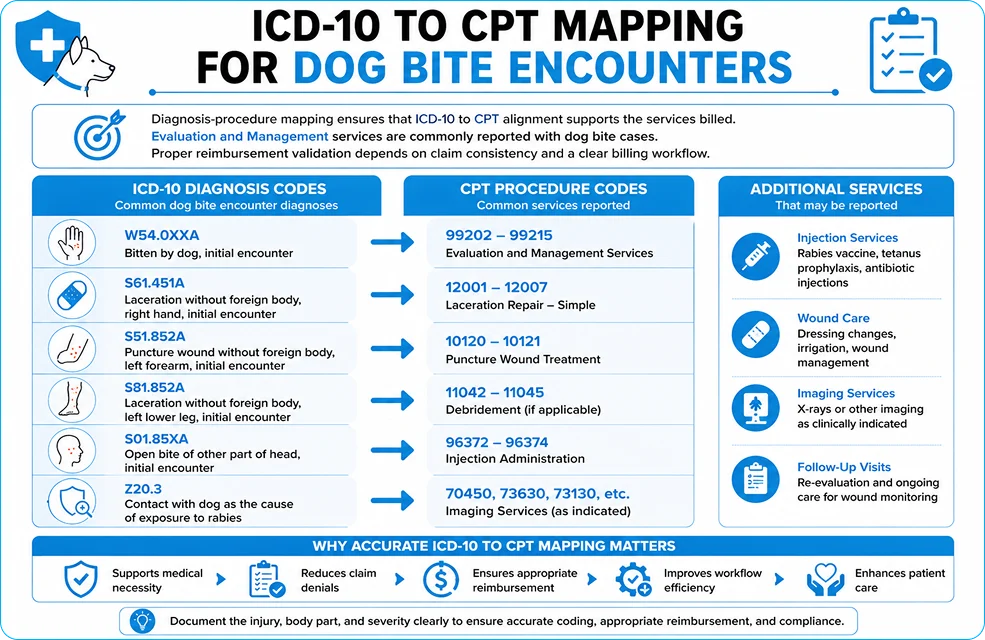
Diagnosis-procedure mapping ensures that ICD-10 to CPT alignment supports the services billed. Evaluation and Management services are commonly reported with dog bite cases.
Additional services may include wound repair, laceration treatment, injections, and imaging services. Proper reimbursement validation depends on claim consistency and a clear billing workflow.
Dog Bite ICD-10 Coding Cheat Sheet
W54.0XXA usage depends on the encounter type and body part specificity. Coders must distinguish between the initial encounter, the subsequent encounter, and the sequela encounter.
External cause codes should always support injury documentation. A quick reference guide improves coding accuracy and reduces avoidable errors.
Conclusion
Dog bite ICD-10 codes play a critical role in standardized documentation and accurate injury reporting. Proper use of the W54.0XXA classification supports healthcare coding practices and billing consistency.
Accurate coding improves patient care, reimbursement protection, and statistical injury analysis. By following best practices, healthcare professionals contribute to healthcare research and promote safer patient outcomes.
FAQs:
What is the ICD-10 code for M92.8?
M92.8 is an ICD-10-CM code that stands for “other specified juvenile osteochondrosis.” It is applicable when a particular form of juvenile osteochondrosis is recorded but does not conform to a more specific M92 classification. Accurate clinical documentation is necessary to substantiate its application.
What is the ICD-10 code for M92.8?
ICD-10-CM code M92.8 represents other specified juvenile osteochondrosis conditions. It is used when the disorder is identified but not classified under named osteochondrosis types. Providers should specify the affected site in documentation when possible.
How to code for a dog bite?
Dog bites are coded using the ICD-10-CM code W54.0XXA for an initial encounter. An additional 7th characters are used for subsequent encounters or sequela. An injury code (such as an open wound code) must also be reported to describe the actual injury.What is the ICD-9 code for dog bite, unspecified?
The ICD-9-CM code for an unspecified dog bite is E906.0. This code was used to identify dog bite injuries before ICD-10 was implemented. ICD-9 codes are now obsolete for current U.S. medical billing.


