

GO BACK
Orthodontic billing varies depending on the clinical, payer, and accounting perspectives. A clean billing system links all 3 parameters, so case fees, claim timing, and insurance rules stay aligned through months of treatment.
Orthodontic Billing vs General Dentistry Billing
Orthodontic billing works when teams track the full case, the stages, and the payer rules at the same time. General dentistry bills are per visit; orthodontics bills have a longer treatment timeline with staged payments.
Case fee accounting vs per-procedure billing
An orthodontic contract uses a global case fee that covers phases such as appliance placement, adjustment visits, and retention. Revenue leakage starts when the office collects a case fee schedule from the patient but submits claims with inconsistent dates, codes, or months of treatment.
A practical control is a case ledger that splits the total fee into 3 buckets:
- Start-of-case balance tied to appliance placement
- Progress balance tied to periodic visits
- Finish/retention balance tied to appliance removal and retainer delivery
CDT Coding for Orthodontics
Orthodontic coding needs a payer perspective and a documentation perspective. The payer wants correct category selection and consistent reporting across months; the chart needs clear proof of what phase the patient is in.
Types of Orthodontic Treatment Codes
Orthodontic treatment codes are classified into:
- Limited orthodontic treatment: D8010–D8040 (primary, transitional, adolescent, and adult dentitions).
- Comprehensive orthodontic treatment: D8070–D8090 (transitional, adolescent, and adult dentitions).
ADA Code for Orthodontics
ADA orthodontic coding standardizes how providers report treatment information on dental claim forms. Orthodontic claims require additional reporting elements because treatment extends across multiple months and depends on appliance timing, treatment duration, and phased reimbursement structures.
Orthodontic claim reporting commonly relies on ADA claim form fields tied directly to treatment progression. Insurance payers use these fields to validate case timelines, benefit usage, and installment eligibility throughout active treatment.
Key ADA Claim Form Elements Used in Orthodontics
| ADA Claim Field | Purpose in Orthodontic Billing |
|---|---|
| Item 40 | Identifies the claim as orthodontic treatment |
| Item 41 | Reports the appliance placement date |
| Item 42 | Reports total months of treatment |
| Treatment Code Section | Identifies limited or comprehensive treatment category |
| Remarks/Attachments | Supports medical necessity and treatment justification |
Why ADA Orthodontic Coding Requires Date Consistency
Orthodontic payers track treatment progression using the original appliance placement date. Date inconsistencies between initial and follow-up claims create reimbursement delays, installment holds, and eligibility conflicts.
High-risk date inconsistencies include:
- Different appliance placement dates across claims
- Incorrect treatment month calculations
- Restarted treatment timelines without documentation
- Retention billing before active treatment closure
ADA Coding Requirements for Orthodontic Attachments
Orthodontic claims often require supporting records before approval or predetermination review. Payers use attachments to validate treatment necessity and confirm treatment classification.
Common orthodontic claim attachments include:
- Panoramic radiographs
- Cephalometric images
- Intraoral photographs
- Diagnostic models or scans
- Treatment plan documentation
- Narrative summaries describing malocclusion severity
Common ADA Orthodontic Coding Errors
Orthodontic coding errors usually occur when claim form data does not match clinical records or financial agreements.
Frequent reporting problems include:
- Incorrect treatment category selection
- Missing appliance placement dates
- Incomplete months-of-treatment reporting
- Unsupported treatment duration estimates
- Missing predetermination references
- Attachment submission failures
Structured claim review before submission improves coding consistency and reduces orthodontic claim rework.
Orthodontic Coding Updates
Coding choices changed in 2022. The AAO notes D8050 and D8060 were deleted as interceptive orthodontic treatment codes starting Jan 1, 2022, and reports shifts into the limited orthodontic treatment framework.
“Visit and Retention” Orthodontic codes
Orthodontic billing also uses:
- D8660 for a pre-orthodontic exam focused on monitoring growth and development.
- D8670 for a periodic orthodontic treatment visit.
- D8680 for orthodontic retention is tied to appliance removal and retainer delivery.
Eligibility, Benefits, and Limits Checks before Treatment
Coverage looks different from plan to plan, so a single-perspective check fails. A clean verification combines the member portal, the plan document, and the benefits call reference.
Run an eligibility check that captures these benefit limits in writing:
- Waiting periods for orthodontics
- Age limits for dependent vs adult orthodontics
- Lifetime maximum (common in orthodontics) rather than an annual max
- Coinsurance percentage and deductible rules
- Appliance exclusions stated by the plan (aligners, lingual systems, branded systems)
A prevention rule helps: coverage gets documented before diagnostic records get converted into a final case start date.
Orthodontic Billing Lifecycle
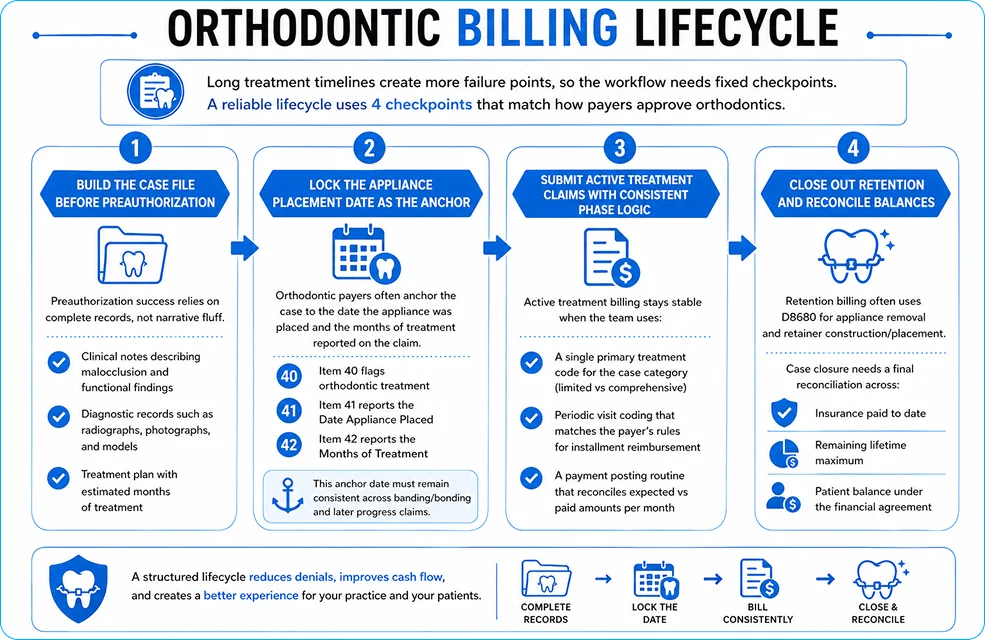
Long treatment timelines create more failure points, so the workflow needs fixed checkpoints. A reliable lifecycle uses 4 checkpoints that match how payers approve orthodontics.
1) Build the case file before preauthorization
Preauthorization success relies on complete records, not narrative fluff. Case packets typically include:
- Clinical notes describing malocclusion and functional findings
- Diagnostic records such as radiographs, photographs, and models
- Treatment plan with estimated months of treatment
2) Lock the appliance placement date as the anchor
Orthodontic payers often anchor the case to the date the appliance was placed and the months of treatment reported on the claim. The ADA claim form completion instructions state:
- Item 40 flags orthodontic treatment
- Item 41 reports the Date Appliance Placed
- Item 42 reports the Months of Treatment
This anchor date must remain consistent across banding/bonding and later progress claims.
3) Submit active treatment claims with consistent phase logic
Active treatment billing stays stable when the team uses:
- A single primary treatment code for the case category (limited vs comprehensive)
- Periodic visit coding that matches the payer’s rules for installment reimbursement
- A payment posting routine that reconciles expected vs paid amounts per month
4) Close out retention and reconcile balances
Retention billing often uses D8680 for appliance removal and retainer construction/placement.
Case closure needs a final reconciliation across:
- Insurance paid to date
- Remaining lifetime maximum
- Patient balance under the financial agreement
How to Submit an Effective Orthodontic Claim
Claims succeed when clinical documentation and claim fields match. A high-clean-rate process uses a pre-submission checklist rather than “fix it after denial.”
Orthodontic claim checklist (12 fields that drive denials)
Use this list before clicking submit:
- The patient’s name and DOB match the eligibility file
- Subscriber ID and group number match the plan
- Billing NPI and taxonomy match payer enrollment
- Treating provider fields match the chart and schedule
- Correct CDT code for the limited vs comprehensive category
- The appliance placement date is recorded once and reused consistently
- Months of treatment match the treatment plan estimate
The appliance - The total case fee matches the patient contract
- Initial payment and installment structure documented
- Enclosures flagged correctly (radiographs, images, narratives)
- Predetermination reference number stored in the case file
- Progress notes support ongoing care for periodic claims
Coordination of Benefits for Two Dental Plans
Two-plan billing needs a payer perspective and a compliance perspective. COB breaks when the team submits out of order or posts payments incorrectly.
A stable COB workflow uses 5 actions:
- Identify primary vs secondary payer using plan rules
- Submit to the primary payer first
- Post the primary EOB to the ledger
- Submit secondary claim with the EOB attached
- Reconcile the patient balance after both responses
COB errors trigger outcomes such as overpayment recovery, denial for duplication, and audit exposure.
Denials: the patterns and the fixes
Denials look random from one claim, but patterns show up across 20–50 cases. A denial log turns “rework” into prevention. When repeated category mismatches or treatment-phase inconsistencies appear across cases, payers may escalate the review beyond simple denials into fraud-monitoring triggers such as upcoding or downcoding audits.
Denial causes that repeat in orthodontics
- Wrong category code (limited vs comprehensive mismatch)
- Appliance placement date mismatch across claims
- Months-of-treatment mismatch across claims
- Missing records for medical necessity reviews in benefit plans that require it
- Eligibility errors tied to waiting period, age cap, or lifetime max exhaustion
Fix the system that reduces repeat denials
- Resubmit with corrected fields and the same anchor dates
- Appeal with a structured packet: records, narrative, plan rule reference, and timeline
- Audit 10 random ortho cases per quarter for date and code consistency
Patient Financial Responsibility:
Patient responsibility becomes predictable when the office documents the same numbers in 3 places: contract, ledger, and claim.
A typical patient balance contains:
- Deductibles and copays
- Coinsurance percentage
- Lifetime max overage after the plan pays its cap
- Installment schedule tied to the case timeline
Example scenario: Case fee $6,000. Ortho lifetime max $1,500. Insurance pays $1,500 total across the case. Patient responsibility becomes $4,500, split into a start payment plus monthly installments.
Conclusion
Orthodontic billing protects revenue when codes, dates, and documentation stay consistent for the full case timeline. A controlled workflow uses one anchor date, one treatment category decision, and a denial log that turns payer feedback into process fixes.
FAQs
What are the “three M’s” in orthodontics?
The “three M’s” are muscles, malformation, and malocclusion, described in classic orthodontic literature.
How does the dental billing process work?
Dental billing follows a repeatable cycle: document services, assign correct CDT codes, submit claims, track payer responses, post payments, and manage remaining accounts receivable.
What are 4 operational steps in the claim process inside a dental office?
- Build the claim from documentation and codes
- Submit the claim to the payer with the required attachments
- Adjudicate by checking status and responding to requests for records
Post and reconcile payments, denials, and patient balances