


GO BACK
Accurate cellulitis coding affects claim approval, reimbursement accuracy, and medical necessity validation. Many cellulitis-related denials occur because providers fail to document the exact anatomical location, laterality, associated infections, or underlying conditions.
ICD-10-CM code L03.115 identifies cellulitis affecting the right lower extremity. Selecting this diagnosis code helps healthcare organizations maintain coding compliance, reduce payer scrutiny, and support proper reimbursement.
This guide explains the clinical meaning of L03.115, coding guidelines, documentation requirements, reimbursement considerations, and common denial prevention strategies.
Understanding ICD-10 Code L03.115
Let’s break down ICD-10 Code L03.115 into segments for an in-depth understanding:
Official ICD-10-CM Definition of L03.115
ICD-10-CM code L03.115 represents Cellulitis of Right Lower Limb. The code is assigned when a provider documents a bacterial skin and soft tissue infection involving the patient’s right lower extremity.
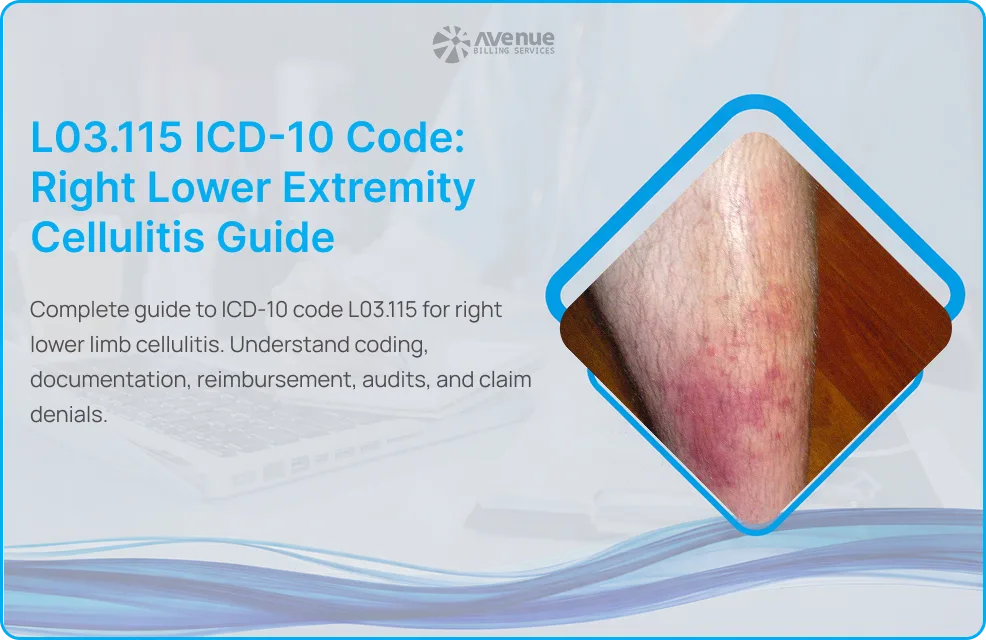
The diagnosis involves infection of the skin and subcutaneous tissues and presents with erythema, warmth, swelling, tenderness, and localized inflammation.
Billable Status and Effective Dates
L03.115 is a billable and specific ICD-10-CM diagnosis code. Because the code identifies both the condition and laterality, it is reported on healthcare claims for reimbursement purposes.
Providers verify the current ICD-10-CM code set applicable to the date of service because annual coding updates affect reporting requirements.
Why Laterality Matters in Cellulitis Coding
Laterality is a critical component of ICD-10-CM coding. The coding system requires providers to identify whether the infection affects the right side, left side, or an unspecified location whenever laterality-specific codes exist.
Using a laterality-specific code:
- Improves claim accuracy
- Supports medical necessity review
- Reduces coding ambiguity
- Minimizes payer denials
- Enhances clinical data reporting
Failure to document laterality forces coders to use unspecified diagnosis codes that carry denial risk.
Anatomical Scope of the Right Lower Limb
The right lower limb includes multiple anatomical structures extending from the hip region to the foot.
For cellulitis coding purposes, the right lower extremity include:
- Right lower leg
- Right calf
- Right ankle
- Right foot
- Soft tissue structures of the right lower limb
However, cellulitis specifically involving the right toe may require a more specific diagnosis code rather than L03.115.
What Is Right Lower Extremity Cellulitis?
Right lower extremity cellulitis is an acute bacterial infection involving the skin and subcutaneous tissue of the patient’s right leg. The infection develops when bacteria enter through a break in the skin barrier.
Portals of entry include:
- Skin ulcers
- Surgical wounds
- Traumatic injuries
- Insect bites
- Cracked skin
- Fungal foot infections
Without prompt treatment, the infection spreads into deeper tissues or progresses to systemic infection.
Common Causes and Risk Factors
Clinical factors that increase susceptibility to lower extremity cellulitis include:
- Staphylococcal infections
- Streptococcal infections
- Chronic skin breakdown
- Diabetes mellitus
- Peripheral vascular disease
- Venous insufficiency
- Lymphedema
- Obesity
- Immunosuppression
Patients with chronic lower extremity swelling experience recurrent episodes of cellulitis.
Clinical Signs and Symptoms Supporting Diagnosis
Clinical documentation should support the diagnosis of cellulitis.
Common findings include:
- Localized redness
- Skin warmth
- Swelling
- Pain or tenderness
- Edema
- Induration
- Fever
- Chills
- Progressive skin inflammation
Providers need to document both the location and severity of clinical findings to support coding specificity.
Associated Clinical Conditions
Certain chronic conditions increase the likelihood of cellulitis development and influence treatment complexity.
Diabetes Mellitus
Diabetes impairs wound healing and increases susceptibility to bacterial infections. Patients with diabetic neuropathy and foot ulcers develop lower extremity cellulitis.
Chronic Edema
Persistent lower extremity swelling disrupts normal skin integrity and creates an environment favorable for bacterial growth.
Lymphedema
Lymphatic dysfunction reduces local immune defense mechanisms and increases the risk of recurrent cellulitis.
Venous Insufficiency
Chronic venous disease contributes to skin breakdown, venous stasis changes, and ulcer formation, creating opportunities for infection.
Peripheral Vascular Disease
Reduced blood flow compromises tissue healing and infection control, making cellulitis more difficult to treat and increasing the risk.
ICD-10-CM Classification and Code Hierarchy
L03.115 belongs to Chapter 12 of the ICD-10-CM classification system, which covers diseases affecting the skin and subcutaneous tissues.
This chapter includes inflammatory, infectious, degenerative, and structural disorders of the skin.
L00–L08 Infections of the Skin and Subcutaneous Tissue
Within Chapter 12, category L00–L08 contains infectious conditions involving the skin and underlying soft tissues.
Examples include:
- Impetigo
- Cutaneous abscesses
- Furuncles
- Carbuncles
- Cellulitis
- Acute lymphangitis
These diagnoses share an infectious etiology but differ according to anatomical site and disease severity.
L03 Cellulitis and Acute Lymphangitis
Category L03 is dedicated to cellulitis and acute lymphangitis. The category provides location-specific diagnosis codes that allow providers to identify the exact affected body region.
Placement of L03.115 Within the ICD-10-CM Hierarchy
The hierarchical classification is:
- Chapter 12: Diseases of the Skin and Subcutaneous Tissue
- L00–L08: Infections of the Skin and Subcutaneous Tissue
- L03: Cellulitis and Acute Lymphangitis
- L03.11: Cellulitis of Lower Limb
- L03.115: Cellulitis of Right Lower Limb
This hierarchical structure demonstrates the specificity required for accurate ICD-10-CM reporting.
ICD-10 Coding Guidelines for L03.115
Understanding Excludes1 and Excludes2 Notes
ICD-10-CM Excludes notes help coders determine whether multiple diagnoses can be reported together.
Excludes1 indicates that two conditions cannot be coded together because they represent mutually exclusive diagnoses.
Excludes2 indicates that the excluded condition is not part of the coded condition. When supported by documentation, both diagnoses are reported together.
Coders review tabular instructions before final code assignment. Failure to review Excludes notes can lead to:
- Incorrect diagnosis assignment
- Duplicate coding
- Claim denials
- Compliance risk
- Audit findings
Conditions Excluded From L03.115 Reporting
Certain skin conditions resemble cellulitis but require different diagnosis codes. Examples include:
- Necrotizing fasciitis
- Contact dermatitis
- Venous stasis dermatitis
- Pressure injuries
- Noninfectious inflammatory disorders
Providers need to establish an infectious process before assigning L03.115.
ICD-10-CM Coding Instructions
When reporting L03.115:
- Confirm provider-documented cellulitis
- Verify right-sided involvement
- Identify associated infections
- Capture linked conditions when documented
- Follow sequencing guidelines for systemic conditions
Diagnosis coding reflects physician documentation rather than laboratory findings alone.
When Should Providers Report L03.115?
L03.115 is appropriate when documentation supports cellulitis affecting the right lower extremity.
Scenarios include:
- Right lower leg cellulitis
- Right calf cellulitis
- Right ankle cellulitis
- Right foot cellulitis
- Post-traumatic cellulitis of the right lower limb
Documentation identifies the affected location.
Right Leg, Ankle, and Foot Cellulitis Coding
Cellulitis involving the right leg, ankle, or foot is reported using L03.115 when a more specific anatomical code is unavailable.
Providers document:
- Exact location
- Extent of infection
- Severity
- Associated wounds
- Presence of drainage or abscess
Common Conditions Reported With L03.115
Certain conditions are coded alongside L03.115 when documented by the provider and clinically relevant to the encounter.
Associated conditions include:
- Diabetes mellitus with infection
- MRSA or MSSA cellulitis
- Venous insufficiency and lymphedema
- Chronic lower-extremity edema
- Peripheral vascular disease
- Sepsis related to cellulitis
- Chronic kidney disease
- Obesity and immunosuppression
Report additional diagnosis codes when supported by provider documentation and ICD-10-CM coding guidelines.
When a Different Cellulitis Code Is Required
Not every right-sided cellulitis diagnosis qualifies for L03.115.
Coders select the specific diagnosis available based on the provider documentation.
L03.031 Cellulitis of Right Toe
When the infection is isolated to the right toe, L03.031 should be reported instead of L03.115.
L03.116 Cellulitis of Left Lower Limb
L03.116 applies when cellulitis affects the patient’s left lower extremity.
L03.90 Unspecified Cellulitis
L03.90 is used when documentation does not identify the affected anatomical location.
Excessive use of unspecified codes increases denial risk.
Coding Cellulitis With Abscess Documentation
Cellulitis and abscess are separate clinical conditions.
When provider documentation supports both diagnoses, coders report:
- Cellulitis diagnosis code
- Appropriate abscess diagnosis code
Documentation supports both conditions independently.
Related ICD-10 Codes for Cellulitis
L03.115 vs L03.116
The primary difference is laterality.
| Code | Description |
| L03.115 | Cellulitis of the Right Lower Limb |
| L03.116 | Cellulitis of the left lower limb |
L03.115 vs L03.031
L03.115 applies to the right lower limb broadly, while L03.031 specifically identifies cellulitis of the right toe.
Toe-specific documentation requires a specific code.
L03.115 vs L03.90
L03.115 identifies a specific anatomical location.
L03.90 identifies unspecified cellulitis and is used when documentation lacks sufficient detail.
Payers prefer specific diagnosis coding whenever possible.
Cellulitis Code Selection Decision Framework
Providers should evaluate:
- Is cellulitis documented?
- What anatomical location is affected?
- Is laterality documented?
- Is a more specific code available?
- Are additional infections present?
Following this process helps reduce coding errors.
L03.115 vs Related Cellulitis ICD-10 Codes
| ICD-10 Code | Description | When to Use |
| L03.115 | Cellulitis of Right Lower Limb | Right lower extremity infection |
| L03.116 | Cellulitis of Left Lower Limb | Left lower extremity infection |
| L03.031 | Cellulitis of Right Toe | Infection limited to right toe |
| L03.032 | Cellulitis of Left Toe | Infection limited to left toe |
| L03.90 | Unspecified Cellulitis | Location not documented |
Conditions Confused With Right Lower Extremity Cellulitis
Deep Vein Thrombosis (DVT)
DVT mimics cellulitis because both conditions cause:
- Swelling
- Pain
- Warmth
- Redness
Diagnostic testing helps distinguish vascular disease from infection.
Venous Stasis Dermatitis
Venous stasis dermatitis causes chronic inflammation and skin discoloration in the lower extremities.
Unlike cellulitis, it is not caused by bacterial infection.
Contact Dermatitis
Contact dermatitis results from exposure to allergens or irritants.
Patients present with:
- Redness
- Itching
- Rash
- Skin irritation
Documentation distinguishes inflammatory skin reactions from infection.
Osteomyelitis of the Lower Extremity
Osteomyelitis involves infection of bone tissue.
Patients with severe cellulitis, diabetic ulcers, or chronic wounds develop underlying bone infections. Additional imaging studies are required.
Lymphedema-Related Skin Changes
Chronic lymphedema cause:
- Swelling
- Skin thickening
- Hyperpigmentation
- Fibrotic tissue changes
These findings resemble cellulitis but represent a different disease process.
Why Differential Diagnosis Matters for Accurate Coding
Accurate diagnosis drives accurate coding.
Coding noninfectious conditions like cellulitis results in:
- Medical necessity concerns
- Audit findings
- Reimbursement issues
- Compliance risk
- Clinical reporting inaccuracies
Providers should document diagnostic reasoning when evaluating lower extremity inflammation.
Clinical Documentation Requirements for L03.115
Required Diagnosis Elements
Documentation establishes:
- Confirmed cellulitis diagnosis
- Affected anatomical site
- Laterality
- Clinical findings
- Treatment plan
Location and Laterality Documentation
Providers document the following to prevent coders from inferring laterality from nursing notes or imaging reports.
- Right lower extremity
- Right leg
- Right calf
- Right ankle
- Right foot
Clinical Findings Supporting Medical Necessity
Medical necessity is strengthened when objective findings support diagnosis validation. The records include:
- Erythema
- Swelling
- Warmth
- Tenderness
- Fever
- Drainage
- Progression of symptoms
Severity and Progression Indicators
Documentation should describe:
- Mild infection
- Moderate infection
- Severe infection
- Rapid progression
- Recurrent episodes
Severity reporting helps establish treatment complexity.
Treatment Plan Documentation
Treatment documentation supports reimbursement and compliance requirements. Records should include:
- Antibiotic therapy
- Wound care
- Follow-up evaluation
- Monitoring instructions
- Hospital admission decisions
Documentation Examples That Support L03.115
Example:
“Patient presents with cellulitis involving the right lower leg. Examination reveals erythema, warmth, edema, and tenderness extending from the ankle to the mid-calf. Oral antibiotic therapy initiated.”
This documentation supports accurate diagnosis assignment.
Documentation Deficiencies That Trigger Denials
Deficiencies include:
- Missing laterality
- Unspecified location
- Lack of clinical findings
- Incomplete assessment
- Unsupported medical necessity
- Missing treatment plan
These issues lead to payer requests for additional documentation.
Clinical Documentation Requirement Matrix
| Requirement | Documentation Example |
| Diagnosis | Cellulitis |
| Site | Right Lower Leg |
| Laterality | Right |
| Clinical Findings | Erythema, edema, warmth |
| Severity | Mild, moderate, severe |
| Treatment | Antibiotics, wound care |
| Follow-Up | Reassessment plan |
Coding Examples for L03.115
Simple Right Lower Extremity Cellulitis
Patient presents with redness, swelling, warmth, and tenderness involving the right lower leg. No underlying conditions or complications are documented.
Coding
- L03.115 Cellulitis of Right Lower Limb
Cellulitis With Diabetes Mellitus
A patient with Type 2 diabetes develops cellulitis involving the right lower extremity, requiring antibiotic treatment.
Coding
- L03.115 Cellulitis of Right Lower Limb
- Appropriate diabetes diagnosis code
Cellulitis With MRSA Infection
Culture confirms MRSA infection involving cellulitis of the right lower leg.
Coding
- L03.115 Cellulitis of Right Lower Limb
- Additional organism-specific diagnosis code
Cellulitis With Sepsis
Patient admitted with right lower extremity cellulitis complicated by sepsis.
Coding
- Appropriate sepsis diagnosis code
- L03.115 Cellulitis of Right Lower Limb
- Additional diagnoses as documented
Sequencing depends on the clinical circumstances and official coding guidelines.
Cellulitis With Abscess
Provider documents cellulitis and abscess involving the right lower extremity requiring incision and drainage.
Coding
- L03.115 Cellulitis of Right Lower Limb
- Appropriate abscess diagnosis code
Cellulitis Coding Scenario Examples
| Scenario | Coding Consideration |
| Simple Cellulitis | L03.115 |
| Cellulitis + Diabetes | L03.115 + Diabetes Code |
| Cellulitis + MRSA | L03.115 + Organism Code |
| Cellulitis + Sepsis | Sepsis Sequencing Required |
| Cellulitis + Abscess | Cellulitis + Abscess Code |
CPT Codes and Healthcare Services Associated With L03.115
Evaluation and Management (E/M) Services
Cellulitis requires E/M services for diagnosis, treatment planning, and follow-up care. Services include:
- Office visits
- Emergency department evaluations
- Hospital evaluations
- Follow-up assessments
Code selection depends on the service level and setting.
Wound Care Procedures
Patients with cellulitis require wound management services. Interventions include:
- Wound assessment
- Debridement
- Dressing changes
- Ongoing wound monitoring
Documentation should support medical necessity for all procedures performed.
Incision and Drainage Procedures
Incision and drainage procedures are medically necessary when abscess formation is present. Documentations identify:
- Abscess location
- Procedure details
- Drainage findings
- Post-procedure management
Intravenous Antibiotic Administration
Moderate or severe infections require intravenous antibiotic therapy. Documentation include:
- Medication administered
- Dosage
- Infusion details
- Clinical response
Observation and Hospital-Based Services
The patients require observation or inpatient management due to:
- Rapid progression
- Failed outpatient treatment
- Systemic symptoms
- Significant comorbidities
Hospital documentation should support the necessity.
CPT Codes Reported With L03.115
CPT and ICD-10 Pairing Reference
| Service Category | Common CPT Codes |
| Office E/M | 99202–99215 |
| Hospital E/M | 99221–99239 |
| Emergency Department | 99281–99285 |
| Incision and Drainage | 10060–10061 |
| Wound Debridement | 11042–11047 |
| IV Infusion Services | 96365–96368 |
Reimbursement Implications of Accurate L03.115 Coding
How Diagnosis Specificity Affects Reimbursement
Specific diagnosis coding strengthens claim accuracy and supports payer review processes.
Benefits include:
- Reduced denials
- Improved claim acceptance
- Better clinical reporting
- Stronger medical necessity support
Specificity is a core ICD-10-CM requirement.
Medical Necessity Validation
Payers evaluate whether documentation supports the services billed. Records demonstrate:
- Confirmed infection
- Clinical findings
- Treatment rationale
- Appropriate level of care
Insufficient documentation results in reimbursement delays.
Outpatient vs Inpatient Payment Considerations
Reimbursement varies according to the care setting.
Outpatient claims focus on:
- Diagnosis support
- Procedure necessity
- Visit complexity
Inpatient reimbursement considers:
- MS-DRG assignment
- Severity of illness
- Comorbid conditions
Financial Impact of Coding Errors
Coding errors result in:
- Claim denials
- Payment delays
- Revenue leakage
- Audit exposure
- Rework costs
Claim Denials Related to L03.115
Unspecified Diagnosis Code Usage
The denials are triggered when providers use unspecified cellulitis diagnosis codes despite documentation supporting a specific diagnosis.
Payers expect:
- Site specificity
- Laterality specificity
- Complete diagnosis reporting
When documentation identifies the right lower extremity, L03.115 is reported instead of an unspecified cellulitis code.
Missing Laterality Documentation
ICD-10-CM requires laterality whenever a laterality-specific code exists.
Claims are denied when documentation fails to specify:
- Right side
- Left side
- Bilateral involvement
Providers document the affected extremity throughout the medical record.
Diagnosis-to-Procedure Mismatch
Diagnosis-to-procedure mismatches occur when billed services are not supported by the reported diagnosis.
Examples include:
- Extensive wound procedures without supporting clinical findings
- Intravenous antibiotic administration without documented infection severity
- Hospital-level services lack medical necessity
Documentation should support every billed service.
Insufficient Clinical Support
Payers request additional documentation when records fail to establish active cellulitis.
Deficiencies include:
- Missing physical examination findings
- Absence of infection indicators
- Incomplete assessment notes
- Lack of treatment rationale
Strong clinical documentation supports claim approval and medical necessity validation.
Abscess and Cellulitis Coding Errors
Documentation references cellulitis and abscess simultaneously.
Coding mistakes include:
- Reporting cellulitis only
- Reporting abscess only
- Failing to capture both conditions when supported
Providers should document each diagnosis independently.
Denial Correction and Appeal Workflow
When cellulitis claims are denied:
- Review the denial reason.
- Verify diagnosis accuracy.
- Review supporting documentation.
- Correct coding deficiencies.
- Submit the corrected claim or appeal.
- Attach supporting records when required.
A structured denial management workflow improves recovery rates.
Denials and Resolution Guide
| Denial Issue | Root Cause | Resolution |
| Unspecified Diagnosis | Missing specificity | Report L03.115 when supported |
| Missing Laterality | Incomplete documentation | Document right lower extremity |
| Medical Necessity Denial | Insufficient findings | Add clinical support |
| Procedure Mismatch | Unsupported service | Verify CPT–ICD relationship |
| Documentation Request | Incomplete records | Submit additional documentation |
| Coding Error | Incorrect diagnosis selection | Correct and resubmit |
Audit, Compliance, and Denial Prevention
CMS Documentation Expectations
CMS expects documentation to reflect the patient’s condition and the services provided.
Cellulitis documentation needs to establish:
- Diagnosis certainty
- Anatomical location
- Laterality
- Severity
- Treatment plan
Incomplete records increase audit vulnerability.
ICD-10 Coding Compliance Standards
Compliance programs ensures:
- Accurate diagnosis assignment
- Proper sequencing
- Documentation consistency
- Coding guideline adherence
- Annual ICD-10 update monitoring
Routine education helps maintain coding accuracy.
High-Risk Audit Triggers
Patterns that attract an auditor’s attention include:
- Excessive unspecified diagnosis use
- Frequent coding corrections
- Repeated cellulitis claims
- Documentation inconsistencies
- Unsupported inpatient admissions
Organizations should monitor these trends.
Internal Coding Audit Checklist
A cellulitis coding audit verify:
- Diagnosis accuracy
- Laterality documentation
- Medical necessity support
- Secondary diagnosis capture
- CPT-to-ICD consistency
- Proper sequencing
Routine audits help identify revenue leakage before payer review.
Claim Scrubbing and Validation Controls
Automated claim review tools detect:
- Missing diagnosis specificity
- Invalid code combinations
- Documentation deficiencies
- Coding inconsistencies
Claim scrubbing improves first-pass acceptance rates.
Provider Documentation Improvement Strategies
Provider education programs emphasize:
- Site-specific diagnosis documentation
- Laterality reporting
- Infection severity documentation
- Comorbidity capture
- Treatment justification
Better documentation improves coding quality and reimbursement performance.
Audit Risk Assessment Matrix
| Audit Risk Area | Risk Level | Prevention Strategy |
| Unspecified Codes | High | Use specific ICD-10 codes |
| Missing Laterality | High | Document right vs left side |
| Incomplete Assessment | High | Include clinical findings |
| Missing Comorbidities | Medium | Capture relevant conditions |
| CPT-ICD Mismatch | High | Validate code pairing |
| Unsupported Admission | High | Document medical necessity |
Final Claim Submission Checklist
- Before claim submission, verify:
- Cellulitis diagnosis documented
- Right lower extremity identified
- Clinical findings documented
- Medical necessity supported
- CPT and ICD-10 codes aligned
- Secondary diagnoses captured
- Documentation signed and complete
- Coding guidelines followed
Conclusion
Accurate reporting of ICD-10-CM code L03.115 depends on clear documentation of right lower extremity cellulitis, including laterality, clinical findings, severity, treatment plan, and any associated conditions. Complete documentation helps support medical necessity, reduces claim delays, and improves coding accuracy.
To minimize denials and compliance risks, providers should use the specific diagnosis code available, follow ICD-10-CM coding guidelines, and capture all relevant secondary diagnoses when documented. Avoiding errors such as unspecified coding, missing laterality, or unsupported diagnoses improves reimbursement outcomes and audit readiness.
Frequently Asked Questions
What is the ICD-10 code for cellulitis of the right lower extremity?
The correct ICD-10-CM code is L03.115, which identifies cellulitis involving the right lower limb or lower extremity.
Is L03.115 a billable diagnosis code?
Yes. L03.115 is a valid billable ICD-10-CM code that is submitted on healthcare claims for reimbursement purposes.
What is the difference between L03.115 and L03.116?
L03.115 represents cellulitis of the right lower limb, while L03.116 represents cellulitis of the left lower limb.
Can cellulitis and diabetes be coded together?
Yes. When documentation confirms both conditions, coders should report cellulitis along with the appropriate diabetes diagnosis code and any related complications.
What documentation is required for L03.115?
Providers should document the cellulitis diagnosis, right-sided location, clinical findings, severity, treatment plan, and any associated conditions that affect patient care.
Why do claims with L03.115 get denied?
The reasons include missing laterality, insufficient clinical documentation, diagnosis-to-procedure mismatches, and the use of unspecified infection codes when a more specific code is available.
Does diagnosis specificity affect reimbursement?
Yes. Specific coding supports medical necessity, reduces claim denials, improves compliance, and helps ensure accurate reimbursement.


