


GO BACK

Revenue decline rarely begins with reduced patient volume. In most healthcare practices, instability originates inside revenue cycle management (RCM). Billing inefficiencies accumulate through delayed follow-ups, coding inconsistencies, and unresolved payer denials.
Financial, operational, and compliance indicators expose these structural weaknesses before revenue loss becomes visible. Rising denial rates, extended accounts receivable aging, and declining collection performance signal a billing system breakdown.
Practices often recognize the need for outsourced billing support only after measurable revenue cycle KPIs deteriorate. Outsourced billing becomes necessary when revenue cycle metrics cross defined risk thresholds.
What Financial Warning Signs Indicate Revenue Instability?
Financial indicators reveal whether a billing system supports stable revenue flow or silently erodes collections.
Rising Days in Accounts Receivable (A/R)
Accounts receivable aging measures how quickly a practice converts claims into collected revenue. When billing workflows weaken, unpaid claims accumulate and aging increases.
Key warning indicators include:
- A/R exceeding 40–50 days
- 90+ day aging surpassing 20–25%
- Delayed payer reimbursements
- Slow or inconsistent follow-up cycles
Extended A/R aging signals claim follow-up delays, denial backlogs, or inefficient revenue cycle management.
Declining Net Collection Rate
The net collection rate reflects how effectively a practice collects revenue after contractual adjustments.
Warning thresholds include:
- Net collection rate falling below 96%
- Increasing contractual write-offs
- Unresolved payer underpayments
- Discrepancies between contracted and paid reimbursement rates
Declining collections indicate gaps in denial recovery, payment reconciliation, or contract monitoring.
Revenue Volatility Month Over Month
Consistent revenue cycles produce predictable cash flow. Billing instability causes irregular revenue patterns.
Common volatility indicators include:
- 10–15% fluctuation in monthly cash flow
- Delayed remittance posting
- Inconsistent payment batching
These patterns frequently originate from delayed claim submission or inefficient payment posting workflows.
What Operational Breakdowns Occur in the Billing Workflow?
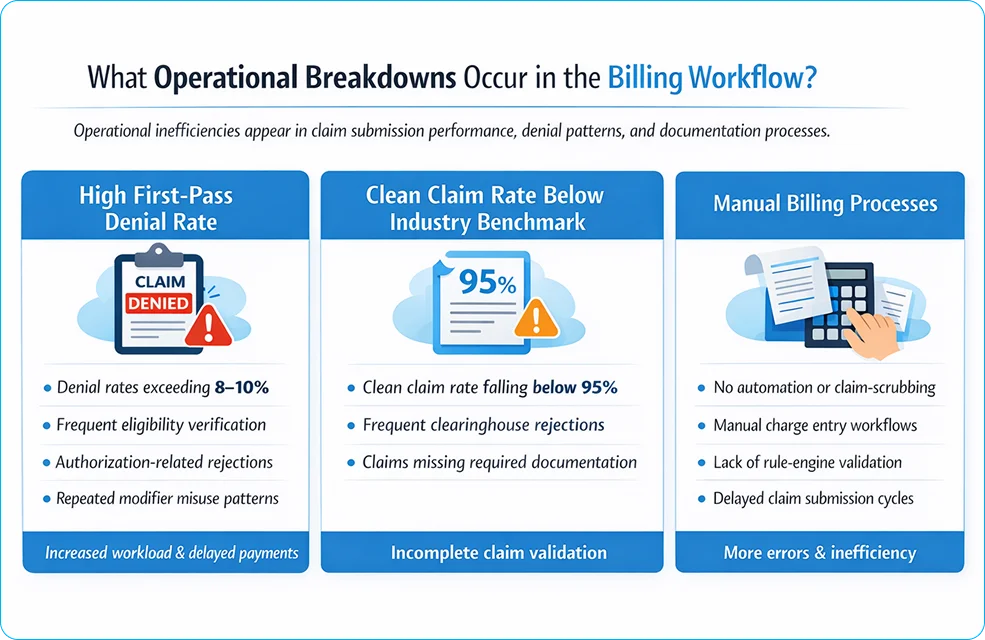
Operational inefficiencies appear in claim submission performance, denial patterns, and documentation processes.
High First-Pass Denial Rate
First-pass denial rate measures the percentage of claims rejected on initial submission.
Risk indicators include:
- Denial rates exceeding 8–10%
- Frequent eligibility verification denials
- Authorization-related rejections
- Repeated modifier misuse patterns
High denial rates increase administrative workload and delay reimbursement cycles.
Clean Claim Rate Below Industry Benchmark
The clean claim rate reflects how many claims are accepted without edits or rejections.
Operational warning signs include:
- Clean claim rate falling below 95%
- Frequent clearinghouse rejections
- Claims missing required documentation
Low clean claim rates signal incomplete claim validation and ineffective claim scrubbing workflows.
Manual Billing Processes
Manual billing systems limit claim accuracy and processing speed.
Common operational gaps include:
- No automation or claim-scrubbing tools
- Manual charge entry workflows
- Lack of rule-engine validation
- Delayed claim submission cycles
Manual billing environments increase claim errors and reduce revenue cycle efficiency.
What Compliance and Audit Risks Signal Billing System Weakness?
Billing errors trigger compliance risks and payer audits when coding and documentation fail to meet regulatory standards.
Repeated NCCI Edit Violations
National Correct Coding Initiative (NCCI) edits prevent improper code combinations.
Frequent violations include:
- CPT code bundling errors
- Modifier conflicts
- Recurring MUE denials
Repeated NCCI failures expose practices to payer scrutiny and audit risk.
Documentation and Coding Mismatch
Clinical documentation must support the billed CPT and ICD-10 codes.
Warning signals include:
- CPT and diagnosis code inconsistencies
- Medical necessity denials
- Coding patterns suggesting upcoding or downcoding
Coding misalignment increases compliance exposure and reimbursement disputes.
Lack of Audit Response Infrastructure
Practices without structured compliance monitoring struggle to respond to payer audits.
Common risk indicators include:
- Delayed payer audit responses
- Absence of internal compliance monitoring
- No revenue integrity review process
Without audit readiness, practices face financial penalties and prolonged payment disputes.
How Do Staffing and knowledge Limitations Affect Billing Performance?
Revenue cycle performance depends heavily on internal billing staff expertise.
Dependence on a Single Biller
Single-staff billing systems create operational risk.
Vulnerabilities include:
- Knowledge silo dependency
- Revenue interruption during leave or absence
- Lack of cross-training systems
If a key billing employee becomes unavailable, claim processing stop entirely.
Billing Staff Turnover
Staff turnover disrupts billing workflows and creates operational instability.
Operational impacts include:
- Repeated staff training costs
- Workflow inconsistencies
- Accumulated claim backlogs
Frequent turnover slows claim submission and delays reimbursements.
Physician Oversight Burden
When billing systems lack structure, physicians absorb administrative workload.
Common indicators include:
- Physicians spending 10+ hours weekly reviewing billing
- Clinical leadership diverted from patient care
- Lack of revenue cycle KPI dashboards
Administrative oversight reduces clinical productivity and slows operational growth.
When Does Practice Growth Exceed Billing Capacity?
Rapid practice expansion increases billing complexity and administrative workload.
Adding New Providers Without Revenue Scaling Plans
Provider onboarding requires structured credentialing and enrollment processes.
Operational gaps include:
- Credentialing delays
- Payer enrollment backlogs
- Delayed revenue activation for new providers
Without revenue cycle planning, provider expansion slows financial growth.
Multi-Location Expansion
Operating across multiple locations increases billing complexity.
Common challenges include:
- State-specific payer policy variation
- Tax ID and NPI configuration errors
- Contract rate inconsistencies
These issues require structured revenue cycle management across locations.
Telehealth or ASC Expansion
New care models introduce additional billing complexity.
Examples include:
- Telehealth POS coding requirements
- Facility vs professional billing coordination
- Payer carve-out network rules
Expansion without billing infrastructure increases denial risk.
What Revenue Cycle Data and KPI Signals Billing Inefficiency?
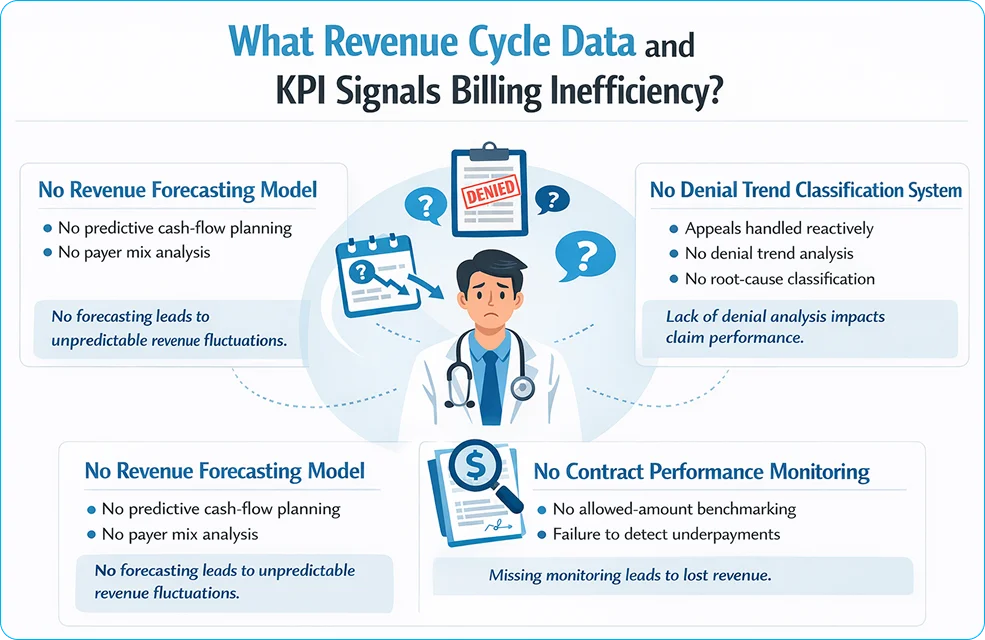
Many practices lack structured revenue cycle analytics.
No Revenue Forecasting Model
Revenue forecasting helps practices anticipate cash flow trends.
Warning signs include:
- No predictive cash-flow planning
- No payer mix analysis
Without forecasting models, practices cannot anticipate revenue fluctuations.
No Denial Trend Classification System
Denial management requires identifying root causes rather than reacting to individual claims.
Operational gaps include:
- Appeals handled reactively
- No denial trend analysis
- No root-cause classification system
Structured denial analytics improves claim performance and prevention.
No Contract Performance Monitoring
Contract monitoring ensures payers reimburse according to negotiated rates.
Common gaps include:
- No allowed-amount benchmarking
- Failure to detect payer underpayments
Without monitoring, practices lose revenue from unnoticed reimbursement discrepancies.
What Happens If You Delay Fixing Billing Issues?
Delaying billing corrections converts recoverable revenue into permanent financial loss and increases long-term operational risk.
Unresolved billing inefficiencies do not remain stable. They compound across claims, payers, and reporting cycles. A small denial backlog gradually becomes a systemic failure affecting cash flow and compliance.
Direct Financial Impact
- Unworked denials accumulate and exceed timely filing limits
- Underpayments remain undetected and unrecovered
- Accounts receivable aging increases beyond recovery thresholds
Operational Impact
- Claim follow-ups become inconsistent
- Staff workload increases without productivity improvement
- Payment posting delays distort revenue reporting
Compliance Risk
- Repeated coding errors trigger payer audits
- Documentation gaps increase medical necessity denials
- Lack of audit readiness leads to financial penalties
Each delay reduces the probability of recovery. Claims move from “collectible” to “written-off” as time passes. Practices that delay intervention experience declining net collection rates and unstable revenue cycles.
What Is the Cost-to-Collect Difference Between In-House and Outsourced Billing?
The cost-to-collect metric compares the operational cost required to generate revenue.
| Metric | In-House Billing | Outsourced Billing |
| Payroll Cost | Fixed salaries | Percentage of collections |
| Technology Cost | Software + clearinghouse expenses | Included |
| Training Expense | Ongoing staff training | Included |
| Denial Recovery Rate | Variable performance | Structured workflow |
| Cost-to-Collect | 6–9% average | 4–7% |
Outsourcing shifts billing costs from fixed operational expenses to performance-based revenue management.
How Can Practices Assess Billing Maturity Using KPI Thresholds?
Practices can evaluate revenue cycle maturity using measurable billing indicators.
Common warning thresholds include:
- Denial rate above 8%
- Accounts receivable over 45 days
- Clean claim rate below 95%
- Net collection rate below 96%
- 90+ day A/R exceeding 25%
- No monthly KPI reporting dashboard
- No contract underpayment monitoring
Practices meeting three or more thresholds require structured revenue cycle intervention.
What Structural Changes Occur With Outsourced Billing Support?
Outsourced billing does not simply replace internal staff. It restructures revenue cycle operations through standardized workflows and measurable performance controls.
Operational improvements include:
- Predictable cash-flow reporting
- Structured denial prevention systems
- Payer-specific rule validation
- Automated eligibility verification
- KPI-based revenue cycle dashboards
- Revenue integrity and compliance monitoring
These systems convert billing from a reactive administrative task into a controlled revenue cycle process.
Outsourced revenue cycle teams such as Avenue Billing Services implement these frameworks through standardized claim validation, payer policy controls, and KPI reporting.
Is Outsourced Billing the Right Strategy for Your Practice?
The decision to outsource billing depends on several operational factors.
Key considerations include:
- Practice size and provider count
- Annual revenue threshold
- Growth stage of the organization
- Compliance exposure and audit risk
Solo practices outsource to reduce administrative workload, while multi-provider organizations outsource to scale billing infrastructure efficiently.
Professional billing companies track revenue cycle KPIs continuously to detect inefficiencies, prevent denials, and optimize reimbursement performance.
These metrics are aligned with industry standards defined by organizations such as Centers for Medicare & Medicaid Services and ensure measurable billing performance.
Core Revenue Cycle KPIs
1. Days in Accounts Receivable (A/R)
Measures how quickly claims convert into payments.
- Target: ≤ 40–45 days
2. Net Collection Rate
Indicates how much collectible revenue is actually received.
- Target: ≥ 96%
3. First-Pass (Clean Claim) Rate
Tracks claims accepted without rejection.
- Target: ≥ 95%
4. Denial Rate
Measures percentage of claims denied on submission.
- Target: ≤ 5–8%
5. 90+ Day A/R Percentage
Identifies aging claims at high risk of non-payment.
- Target: ≤ 20–25%
6. Cost-to-Collect
Evaluates operational efficiency of billing processes.
- Target: 4–7%
Performance Control Systems
Professional billing teams do not just track KPIs—they act on them:
- Denial trend classification to identify root causes
- Payer-specific performance analysis
- Underpayment detection against contracted rates
- Monthly KPI reporting dashboards
Continuous KPI monitoring transforms billing from a reactive process into a controlled revenue system. This ensures consistent cash flow, faster reimbursements, and reduced financial risk.
Get a Revenue Cycle Diagnostic Review from Avenue Billing Services
Before outsourcing decisions are made, practices should assess the health of their revenue cycle. Avenue Billing Services provides structured diagnostics that uncover denial patterns, billing inefficiencies, and reimbursement gaps affecting practice revenue.
A revenue cycle diagnostic typically includes:
- KPI performance analysis
- Accounts receivable aging review
- Denial trend evaluation
- Contract underpayment detection
Early identification of revenue leakage allows practices to correct billing weaknesses before operational growth stalls.
Conclusion
Practices that monitor revenue cycle KPIs early prevent reactive billing decisions. Persistent indicators such as rising A/R aging, declining collection rates, and increasing denial patterns signal structural weaknesses in billing operations.
When these performance thresholds remain unresolved, outsourcing becomes a strategic restructuring of the revenue cycle. Structured billing workflows improve collection stability, reduce administrative burden, and support sustainable practice growth.
Frequently Asked Questions
How do you know when a practice should outsource medical billing?
A practice should consider outsourcing billing when key revenue cycle metrics decline. Common indicators include denial rates above 8%, accounts receivable aging exceeding 45 days, clean claim rates below 95%, or net collection rates below 96%.
What percentage of revenue does outsourced medical billing cost?
Most outsourced billing services charge between 4% and 7% of collections, depending on practice size, specialty complexity, and claim volume. This cost replaces internal payroll, training, and billing software expenses.
What are the most common problems with in-house medical billing?
In-house billing challenges include staff turnover, limited payer policy knowledge, manual claim processing, delayed denial follow-up, and lack of revenue cycle analytics.
Can outsourced billing reduce claim denial rates?
Yes. Outsourced billing teams implement structured claim validation, payer rule verification, and denial prevention workflows. These processes improve clean claim rates and reduce first-pass claim rejections.
Does outsourcing billing affect compliance and audit readiness?
Outsourced billing providers include coding compliance monitoring, audit documentation support, and revenue integrity reviews, which strengthen regulatory compliance and reduce audit risk.