GO BACK
Accurate CPT coding in healthcare is as important as clinical practices. Coding mistakes lead to reduced reimbursements and compliance risks. Claim denials often happen due to billing errors, improper coding, and missing modifiers. CMS (Centers for Medicare & Medicaid Services) data shows that Medicare paid $31.7 billion in wrong payments in 2024. This shows how expensive it can be to code incorrectly.
Proper coding helps healthcare providers increase reimbursement and prevent claim denials. Cardiology offices lose money in billing and audit failures. Missing documentation or an incorrect modifier can trigger audits, fines, and claim denials. This blog explains how to prevent common billing and coding mistakes.
For billing in cardiology, CPT Code 93000 is very important. Doctors often use it to do electrocardiograms (ECGs/EKGs), which evaluate the heart’s rhythm and electrical activity. People often confuse CPT 93000, CPT 93005, and CPT 93010. These codes stand for different parts of a service. This blog explains how to prevent common billing and coding issues.
What Is CPT Code 93000?
A full electrocardiogram procedure is what CPT Code 93000 means. It includes a standard 12-lead ECG, which records the heart’s electrical activity, a doctor’s interpretation, and a formal report. This diagnostic tool gives you information that can help you figure out how healthy your heart is and find heart problems like arrhythmias.
Clinical and Billing Context of CPT Code 93000
CPT code 93000’s global service includes technical and professional services. The technical side includes how to place ECG leads, how to get a tracing, and how to use the equipment. A qualified doctor interpreting the results and writing a report is part of the professional side.
According to CMS (Centers for Medicare & Medicaid Services), global billing services are applicable for technical and professional services provided by the same organization, so modifiers 26 and TC are not required.
CPT Code for EKG in Office
Electrocardiogram (EKG/ECG) services performed inside a physician’s office are billed using specific CPT codes based on how the test is provided and interpreted.
Common office-based EKG CPT codes include:
| CPT Code | Description | Billing Scenario |
|---|---|---|
| 93000 | Complete EKG with tracing, interpretation, and report | Physician performs and interprets the EKG in-office |
| 93005 | Tracing only, without interpretation | Office performs test but another provider interprets it |
| 93010 | Interpretation and report only | Provider interprets externally performed EKG |
An EKG is commonly ordered to evaluate:
- Chest pain
- Arrhythmias
- Shortness of breath
- Hypertension-related cardiac changes
- Pre-operative cardiovascular assessment
Accurate EKG billing depends on proper documentation of:
- Medical necessity
- Physician interpretation report
- Symptom or diagnosis linkage through ICD-10-CM codes
- Time and date of service
Incorrect modifier usage, missing interpretation reports, or unsupported diagnosis codes frequently trigger payer denials for office-based EKG claims.
ECG CPT Codes 93000 Series
The ECG CPT Codes 93000 series encompasses a range of codes used to document various types of electrocardiogram (ECG) procedures, which assess the electrical activity of the heart. These codes are crucial for billing and insurance reimbursement purposes, and they categorize ECG procedures based on complexity, type, and method of performance.
CPT Code 93016 – Electrocardiogram, Telemetry (Continuous Monitoring)
Used for continuous ECG monitoring, often in hospital settings, this code applies when patients are being monitored in real-time, either in an inpatient or outpatient setting, for extended periods. Telemetry allows for immediate analysis and intervention if abnormalities occur.
CPT Code 93000 – Electrocardiogram, Routine (12-lead)
This is the most common ECG procedure, involving a 12-lead electrocardiogram used for routine diagnostic purposes. It includes the application of electrodes, recording, and interpretation by a physician. It’s typically used to evaluate heart rhythm, rate, and other electrical activity.
CPT Code 93005 – Electrocardiogram, with Interpretation and Report
This code is used when an ECG is performed and the results are interpreted by a healthcare provider. It combines the act of recording the electrocardiogram with a professional interpretation and a written report of findings, making it a more detailed service than the basic 93000.
CPT Code 93010 – Electrocardiogram, with Exercise (Treadmill, Bicycle)
This code refers to an ECG performed during exercise, typically to diagnose heart conditions under physical stress. It is often used in cardiac stress tests to monitor the heart’s response to exercise. It requires additional equipment like a treadmill or stationary bike, and it may require specific clinical documentation to justify the stress component.
CPT Code 93015 – Electrocardiogram, Ambulatory (Holter Monitoring, 24 hours or more)
Holter monitoring provides continuous ECG monitoring over 24 hours or more to capture any abnormal heart rhythms that might not appear during a standard ECG. This extended period allows for the detection of intermittent arrhythmias or transient issues that are not captured in a single ECG.
CPT 93000 is billed when the complete service is provided by a single organization. Billing depends on who performed the test and who interpreted it. These component-based billing situations are very common in cardiology medical billing services where ECG tracing and interpretation are performed at different locations.
CPT 93000 applies if the same provider does both. If different providers do each part, use CPT 93005 and CPT 93010 to split the services and follow payer rules.
ECG CPT codes vary depending on which portion of the service is performed. Clinics often report CPT 93005 when they send the tracing to another provider for interpretation.
Global vs Split Billing for CPT Code 93000 (26 vs TC Explained)
Global vs Split Billing for CPT Code 93000
Global Billing
Reporting CPT 93000 globally indicates that both the technical and professional components of the ECG service were completed by the same provider. In this case, a single claim is submitted, covering the entire ECG service.
- One claim pays for the whole ECG service.
- Common in: Doctor offices performing on-site ECGs.
Split Billing
Split billing is used when the technical and professional components are billed separately. Modifier TC applies for the technical portion, which includes tracing, equipment use, and staff time. Modifier 26 applies when only the professional interpretation is billed.
- Modifier TC used for technical component billing.
- Modifier 26 used for professional interpretation billing.
- Common in: Outpatient departments, IDTFs with external tracings, and separate physician interpretations.
Key Takeaways
1. Global Billing: One claim for both components (technical + professional).
2. Split Billing: Separate claims for the technical (modifier TC) and professional (modifier 26) components.
Split billing is more common in hospitals, IDTFs, and outpatient settings.
Reporting CPT 93000 globally indicates that the same provider completed both the technical and professional components. In this case, one claim pays for the whole ECG service.
Modifier TC applies when only the technical part is given. This includes tracing, using equipment, and staff time, and it usually matches CPT 93005. When only the professional interpretation is provided, modifier 26 is appended to report the physician’s interpretation separately, typically with CPT 93010.
CPT 93000 is common in doctor offices that do ECGs on-site. Split billing happens more often in outpatient departments of hospitals. IDTFs frequently conduct tracings externally, with interpretation billed separately by physicians.
Clinical Situations for CPT 93000
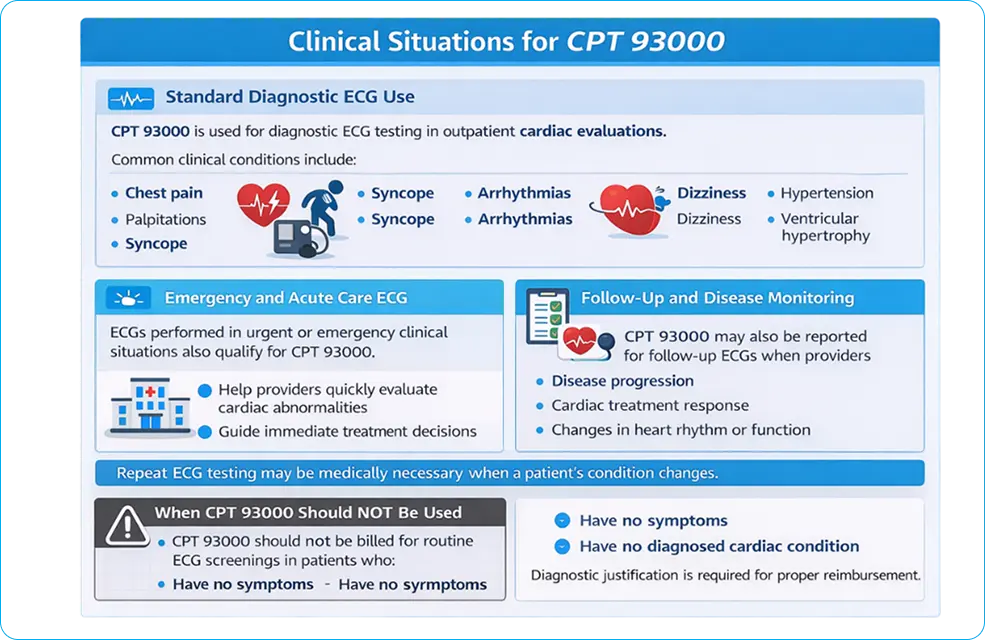
CPT 93000 is the right code for standard diagnostic ECGs that are done in an outpatient setting and for heart evaluations. It supports assessments for chest pain, palpitations, syncope, arrhythmias, dizziness, hypertension, and ventricular hypertrophy.
Emergency ECGs in acute care settings and follow-up ECGs to track the progress of a disease or the effects of treatment also count. When things change, it may be medically necessary to do ECGs again.
You shouldn’t bill the 93000 code for routine screenings of patients who do not have any symptoms or diagnosed heart problems.
How the Place of Service (POS) Affects CPT 93000 Billing
Where the service takes place affects the bill. POS 11 is for doctors’ offices and ECGs done on an outpatient basis. POS 19 and POS 22 are for hospital outpatient departments, and they have different rules for billing outpatients. POS 21 stands for inpatient services, which often include ECGs.
Choosing the wrong POS can result in stuck ECG claims, denied payment, and lower reimbursement. Many practices face repeated POS related claim denials that require dedicated denial review and correction.
Does 93000 CPT Code Need a Modifier?
Yes! In specific conditions cpt code 93000 requires a modifier to explain the case effectively. Modifier 26, modifier TC, modifier 59, modifier 76, modifier 77, and modifier 91 are some of the most common ones. These modifiers make it clear who is responsible for each part and stop duplication.
CMS and AMA CPT guidelines require appropriate modifier use to prevent overlapping claims. There must be a medical reason for repeat ECGs. It is essential to keep clear records of same-day ECGs, changes in condition, and serial ECGs.
Strong documentation includes patient identifiers, signed interpretation reports, clinical notes, and a clear reason for the ECG to show that it was medically necessary.
ICD-10 Diagnosis Codes to Pair with CPT 93000
Payers require the symptoms that are reported to match the diagnoses that are confirmed. Heart problems like arrhythmias, coronary artery disease, heart block, pulmonary embolism, sinus tachycardia, and ST-T changes are reasons to get an ECG.
A common reason for claim denials is a mismatch in diagnosis. Medical necessity logic has to link symptoms, doctor’s orders, and ICD-10 codes.
Medicare and Payer Reimbursement for CPT 93000
The Medicare Physician Fee Schedule (MPFS) pays for CPT 93000 depending on where you live and what your contract says.
Medicare Advantage plans may have different rules for getting approval for each plan than traditional Medicare. Risks of underpayment include missing component billing and contractual allowances.
CMS frequency limits, Local Coverage Determinations (LCDs), and National Coverage Determinations (NCDs) make it hard to bill for ECGs more than once. Screening ECG limits only apply to patients who do not have any symptoms.
Best Practices for Billing CPT 93000
Providers may report CPT 93000 with E/M services such as 99214 using modifier 25 when the services are separately identifiable and medically necessary. Cardiac stress tests (CPT 93015–93018) include ECG monitoring, while Holter monitoring (CPT 93224–93227) and pacemaker evaluations (CPT 93279–93298) may be reported separately with modifier 59 when appropriate.
Avoid bundling or unbundling mistakes under the National Correct Coding Initiative (NCCI). Use internal workflow checklists to review the claims, modifiers, and documentation prior to submitting a claim.
Why Denials in CPT 93000 Billing
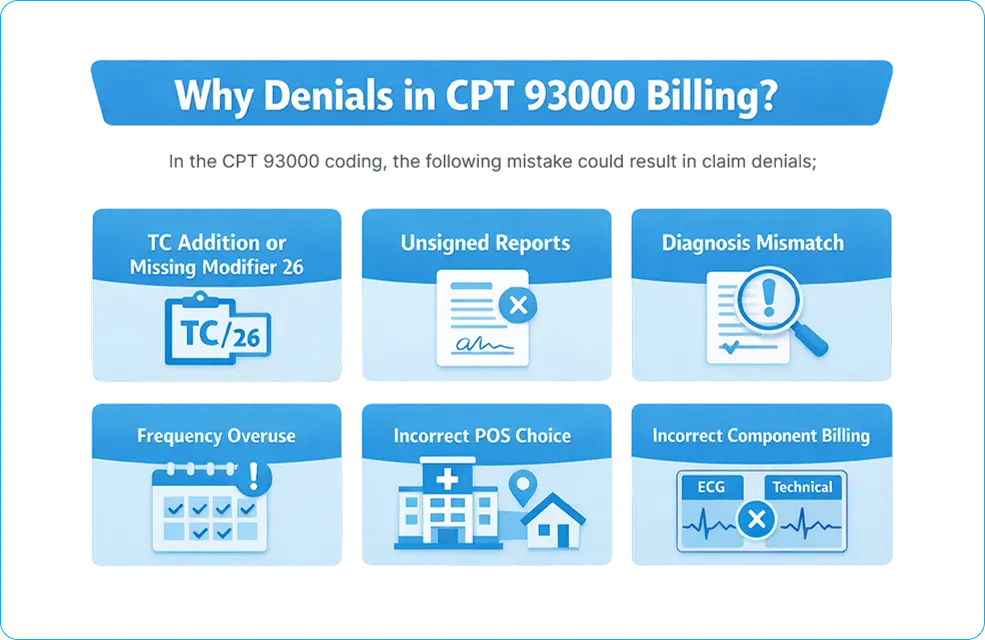
In documentation and billing pf 93000 CPT code, the following mistakes could result in claim denials:
- TC addition or missing modifier 26
- Reports on unsigned interpretations
- Mismatch in diagnosis
- Overuse exceeding frequency thresholds
- Incorrect POS choice
- Incorrect component billing
Risks of Audit and Compliance
High-frequency ECG billing increases the likelihood of audits. Incomplete records and improper modifier use frequently trigger duplication flags. CMS and OIG audits often uncover unsigned or inaccurate documentation.
To remain compliant, you must be truthful, maintain correct records, and abide by AMA CPT regulations.
Conclusion
For accurate cardiology billing and prompt payment, CPT Code 93000 is essential. Understanding the difference between global and split billing, applying the correct modifiers, and selecting the proper place of service significantly reduces the risk of claim denials.
You can avoid frequent audits and underpayments by following CMS, LCD, and NCD regulations. Small errors, such as unsigned reports or missing modifiers, can lead to numerous billing issues. Preventing these recurring issues often requires expert support in ECG claim denial recovery and billing workflow improvement. By adhering to NCCI principles and best practices, healthcare practices may protect their funds and steer clear of audits. Correctly billing for CPT 93000 involves more than just receiving payment. Maintaining compliance is also another aspect of it.
FAQs:
Can you bill CPT 93000 along with an E/M service?
Yes, when it’s medically necessary and different, use modifier 25.
When is it better to use 93000 instead of 93005 or 93010?
If the same provider does both tracing and interpretation, use CPT 93000.
What papers do you need for CPT 93000?
A clinical history, a doctor’s order, an interpretation report, and an ICD-10 diagnosis.
Do the same rules apply to Medicare Advantage?
Not always. Medicare Advantage plans have rules and documentation requirements that are specific to each payer.