

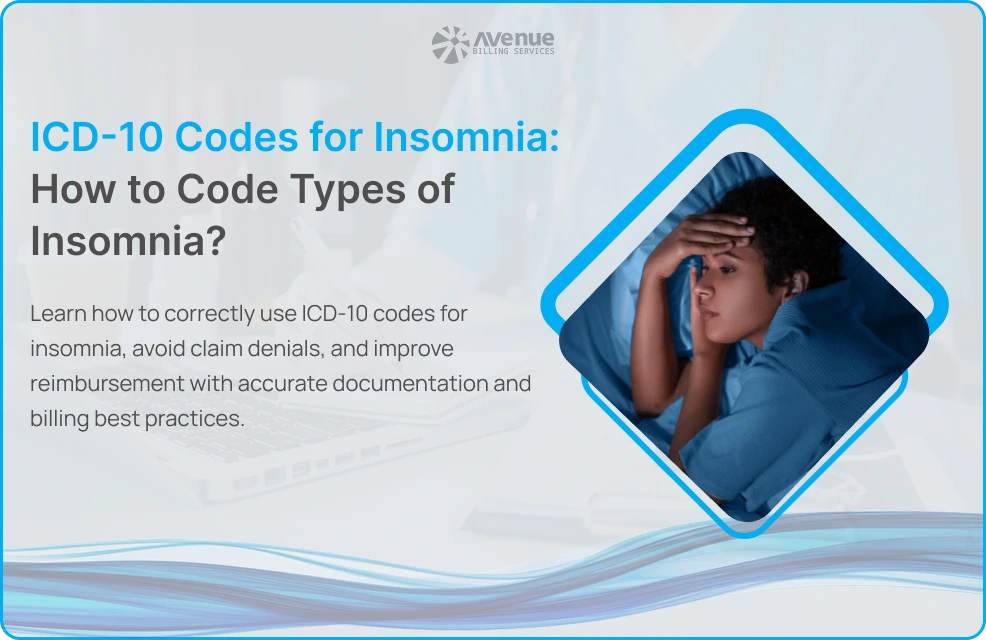
Incorrect insomnia coding triggers claim edits, medical-necessity requests, denials, and delayed reimbursement. Insomnia coding works best when the diagnosis is clearly supported in the assessment and treatment plan, and the selected ICD-10-CM code matches the documented cause.
This guide explains:
- How insomnia is defined clinically
- Which ICD-10-CM codes apply to common insomnia scenarios
- How to code insomnia with comorbid medical or mental health conditions
What is Insomnia?
Insomnia is a sleep disorder involving difficulty falling asleep, staying asleep, or getting good-quality sleep, even with adequate opportunity and a supportive sleep environment. Daytime impairment appears as fatigue, sleepiness, reduced focus, or functional disruption.
Chronic insomnia is commonly defined as symptoms occurring at least three nights per week for at least three months.
What are the ICD-10 Codes?
ICD-10 codes (International Classification of Diseases, 10th Revision) are standard codes that doctors use to describe diseases, symptoms, and conditions.
In medical billing, these codes are used to show that something is medically necessary to support treatment plans. These codes also help to decide if insurance claims should be paid.
Why Understanding Insomnia ICD-10 Codes Is Important
Different sleep disorders require different ICD-10 codes, so the diagnosis must be specific in the assessment. So, the doctor and medical billers need to be very clear about the patient’s condition when filling out claim submission and reimbursement forms. Correct insomnia coding makes sure you get paid correctly and on time.
In my experience, with the right codes and documentation, not only does the number of claim approvals increase, but it also helps provide better care for patients. Insomnia is a sign of a mental health, neurological, or medical problem, so accurate coding helps payers figure out if insomnia is the main problem or just a sign of another one.
Learning about ICD-10 codes for insomnia and understanding when to use primary vs. comorbid codes makes claims much more accurate and saves both money and time.
Types of Insomnia with respect to Coding
Coding decisions depend on the cause and clinical positioning in the note.
Primary insomnia
Primary insomnia appears as an independent diagnosis with documentation showing insomnia as the primary treatment focus and not attributable to another condition.
Insomnia due to a medical condition
Insomnia links to a documented medical cause (examples: chronic pain disorder, cardiopulmonary disease, endocrine disorder, neurologic disorder). Documentation must state the causal relationship.
Insomnia due to a mental disorder
Insomnia links to a documented mental health cause (examples: major depressive disorder, generalized anxiety disorder, PTSD). Documentation must state the causal relationship and reflect active management.
Comorbid insomnia
Comorbid insomnia exists alongside another condition and requires coding based on what the clinician documents:
- Insomnia as a separately treated problem
- Insomnia as a symptom or consequence of the primary condition
- Insomnia as a factor worsening the primary condition
Primary ICD-10 Codes
These are the most commonly used codes for insomnia:
| ICD-10 Code | Description | Use of Code |
| G47.00 | For unspecified insomnia | When the specific cause or type of insomnia is not identified. |
| G47.09 | Other insomnia | Used for specific types of insomnia that are not classified in G47 codes. |
| G47.01 | Insomnia because of any medical condition | When insomnia is linked to a known medical issue. |
| F51.05 | When any mental disorder is a cause of insomnia | Used for known mental health reasons that lead to insomnia |
| F51.01 | Primary insomnia | Insomnia exists independently, but not by any other condition |
Comorbid ICD-10 Codes
These are the codes applicable to cases in which insomnia is present along with any other medical condition.
| ICD-10 Code | Description | Use of Code |
| F32.9 | Unspecified major depressive disorder, one episode | Depression frequently disrupts sleeping patterns and causes chronic insomnia. |
| G47.33 | Adults with obstructive sleep apnea | Sleep apnea is commonly associated with insomnia, which requires dual coding. |
| F41.1 | Generalized anxiety disorder | Anxiety can result in insomnia by making it difficult to fall or stay asleep. |
| R53.83 | Additional fatigue | Chronic fatigue is a frequent occurrence with sleep disorders, including insomnia. |
| M79.7 | Fibromyalgia | Secondary insomnia is frequently caused by pain-related disorders such as fibromyalgia. |
Transition from ICD-9 to ICD-10
Transition from ICD-9 to ICD-10 is required when a case of limited and less diagnosed insomnia shifts to a more detailed and specific diagnosis.
| ICD-9 Code | Description | Use of Code | ICD-10 Code for this |
| 307.41 | Issues with starting or staying asleep in the short term | A medical condition causing insomnia | G47.01 |
| 307.42 | A disorder that persists in starting or keeping sleep | Additional sleeplessness | G47.09 |
| 327.01 | Sleeplessness as a result of a disease | A medical condition causing insomnia | G47.01 |
| 780.52 | Unspecified sleeplessness | Insomnia, unspecified | G47.00 |
Coding Guidelines and Exclusion Notes
To code insomnia correctly, you need to read the ICD-10 guidelines very carefully. Coders need to check if insomnia is primary or secondary and make sure that the code matches the clinical assessment of a doctor. A lot of the time, denials happen because the documentation is wrong or exclusion notes are ignored.
Understanding Exclude 2 Notes
Notes that say “Exclude 2” mean that both conditions can be coded together in one documentation. This is the case when insomnia is present with other mental health or medical problems.
Documentation Requirements for Accurate Coding
The following are the major requirements for precise documentation:
- A clear diagnosis of insomnia should be documented
- What kind of insomnia is it, and why does it happen in detail
- If it’s secondary, make sure to connect it clearly to the underlying medical condition.
- Describe the period and severity of insomnia
- Note symptoms and complications that occur together.
- Note the healthcare provider’s clinical assessment that explains why insomnia needs to be treated
- Write down the management plan to show that active treatment is required
- Ensure that the diagnosis, assessment, and plan are the same on all the documents.
Conclusion
Accurate insomnia coding depends on etiology-based code selection and documentation that supports medical necessity. Specific coding supported by a clear assessment reduces denials compared to vague diagnosis reporting. Correct pairing with comorbid conditions improves claim clarity, supports reimbursement, and strengthens clinical reporting.
FAQs
Which ICD-10-CM code is commonly used for unspecified insomnia?
G47.00 reports insomnia when documentation supports insomnia but does not specify the type or cause.
Can insomnia and a mental health condition be coded together?
Dual coding can be appropriate when documentation supports both diagnoses and active management and excludes notes that do not prohibit pairing.
Is insomnia always a primary diagnosis?
Insomnia may be primary or attributed to a medical or mental health condition based on the clinician’s assessment and documented linkage.
Why do insomnia claims get denied?
Denials follow a diagnosis-to-documentation mismatch, unspecified coding without supporting detail, missing linkage for cause-based codes, or insufficient evidence of medical necessity.
How does ICD-10-CM improve insomnia billing compared to ICD-9?
ICD-10-CM offers more specific insomnia categories and supports clearer cause-based selection, which improves claim clarity when documentation matches the chosen code set.