
Category: CPT Codes

CPT Code 4323902: A Complete Guide to Coding and Billing

Apply the right codes to upper GI tract treatments for faster claims approval and high reimbursement. CPT 43239 is commonly used for endoscopy, and its incorrect use causes frequent denials. There is a high occurrence of mistakes by the coders in choosing a code that follows diagnostic esophagogastroduodenoscopy (EGD) and the other that uses biopsy.  

By mastering CPT 43239, medical coders, billers, and gastroenterologists can minimize audit risk and avoid denials. This guide defines the occasions on which to apply the code and how to prevent the prevalent mistakes of billing.  

Understanding EGD With Biopsy

A biopsy EGD is a transoral upper GI endoscopy that is flexible. The endoscope is inserted into the mouth by the physician into the esophagus, stomach, and duodenum. 

You use biopsy forceps to get tissue samples. Histopathology testing is done on these tissue samples. A biopsy can help find inflammation, infection, abnormal mucosa, or cancerous changes that cannot be seen just by looking at them.

What Is CPT Code 43239  

CPT 43239 represents an esophagogastroduodenoscopy with biopsy. It is used for upper GI endoscopy, with tissue samples used to make a diagnosis. Only in the case of a biopsy conducted in the same session is the code applicable. The cpt 43239 is not defined to be a diagnostic-only code, but the biopsy is the most significant element. In case no tissue is sampled, the code should not be reported. 

CPT 43239 is used to find problems in the upper GI tract. The esophagus, stomach, and duodenum are all parts of this. The procedure lets doctors check for conditions that need to be examined under a microscope.

Biopsies are useful for finding out if someone has an inflammatory disease, an infectious disease, or cancer. They also help with staging diseases and making long-term decisions about how to treat gastrointestinal disorders.

What was actually done during the endoscopy will help you choose the right CPT code. You should only choose CPT 43239 when a biopsy is done and recorded. If you use this code incorrectly, you could get downcoding, denials, or audits.

When to Use CPT 43239

When a biopsy is done, CPT 43239 should be reported and clearly written down in the operative note. Tissue sampling must be medically necessary and backed up by clinical symptoms or findings.

The biopsy must be intentional and not incidental. Documentation should explain why the biopsy was required and what abnormal findings prompted tissue collection.

What CPT Code 43239 Covers

CPT 43239 does not include polypectomy or lesion removal. If a polyp or lesion is removed, a different CPT code applies. Bleeding control procedures are also excluded from this code.

Diagnostic EGD without biopsy is reported using CPT 43235. It is wrong to code CPT 43239 without a biopsy.

Practical Use Cases of 43239 CPT Code

Practical Use Cases of 43239 CPT Code

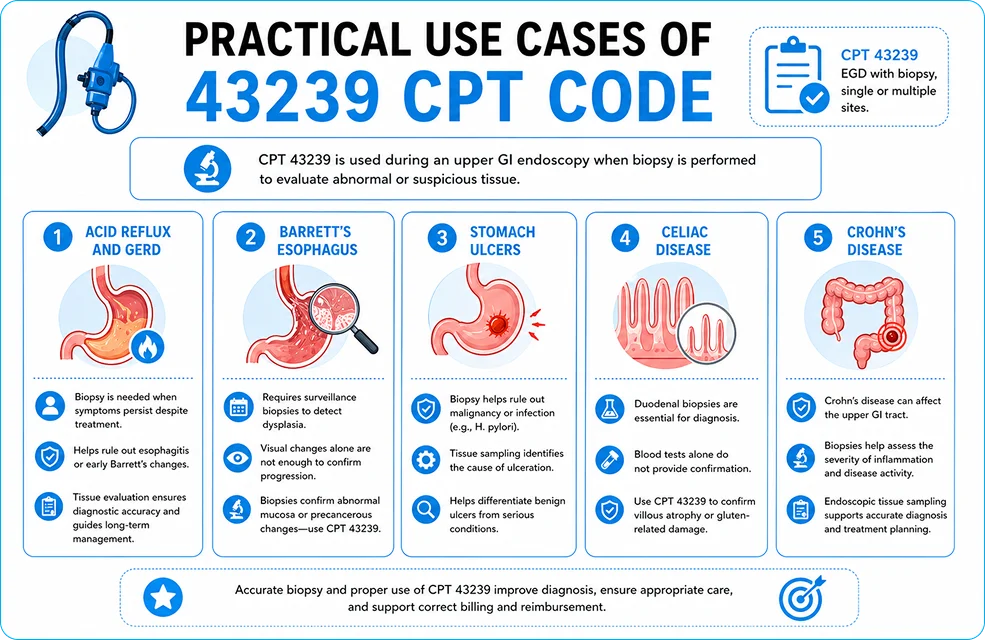
Here are some common situations where you should report CPT 43239.

Acid Reflux and GERD

People with chronic gastroesophageal reflux disease may need a biopsy if their symptoms do not go away even after treatment. Biopsies help rule out esophagitis or early Barrett’s changes.

Tissue evaluation provides diagnostic accuracy and aids in the formulation of long-term management strategies for reflux-related disorders.

Barrett’s esophagus

It usually needs surveillance biopsies to look for dysplasia. Changes in vision alone are not enough to prove that the disease is getting worse.

When biopsies are done to confirm abnormal mucosa or find precancerous changes, CPT 43239 is used.

Stomach Ulcers

A biopsy may be necessary for peptic ulcers to eliminate the possibility of malignancy or infection. Tissue sampling helps find out what is causing the ulceration. Biopsies also help tell the difference between harmless ulcers and more serious problems.

Celiac Disease

Duodenal biopsies are used to diagnose celiac disease. Blood tests alone do not provide confirmation.

If tissue samples are taken to confirm villous atrophy or damage related to gluten, CPT 43239 is the right code to use.

Crohn’s Disease

Crohn’s disease can have an impact on the upper GI tract. Biopsies are useful for figuring out how bad inflammation and disease are. Endoscopic tissue sampling aids in precise diagnosis and treatment formulation.

Other Clinical Signs under 43239 CPT Code

CPT 43239 is also used for anemia that can’t be explained, bleeding in the upper GI tract, and cancer that is suspected. Unusual imaging results may also lead to a biopsy.

These situations necessitate histopathologic validation to inform clinical decisions.

How Payers Evaluate Medical Necessity for CPT 43239

Clinical Indicators That Justify Biopsy During EGD

Payers do not approve CPT 43239 based on procedure alone—they evaluate clinical triggers that justify tissue sampling.

Key indicators include:

  • Persistent GERD symptoms despite treatment
  • Unexplained iron deficiency anemia
  • Upper GI bleeding or melena
  • Suspicious mucosal abnormalities on imaging
  • Surveillance for premalignant conditions (e.g., Barrett’s esophagus)

Biopsy must be linked to objective findings, not routine exploration. Lack of clear clinical reasoning leads to denials.

Documentation Elements Payers Audit First

During claim review, payers focus on specific documentation checkpoints:

  • Explicit mention of biopsy performed
  • Exact anatomical site (esophagus, stomach, duodenum)
  • Number of samples collected
  • Clinical reason linked to ICD-10 diagnosis
  • Pathology submission confirmation

Missing any of these elements creates a documentation gap, which directly results in denial under medical necessity rules.

ICD-10 to CPT Alignment Framework

Correct pairing of diagnosis and procedure determines claim acceptance.

Clinical ConditionICD-10 CategoryBiopsy Justification Strength
GERD with complicationsK21.xModerate–High
Barrett’s EsophagusK22.7High
Gastric UlcerK25.xHigh
Unexplained AnemiaD50.xConditional
Suspected MalignancyCxx.x / R93.xVery High

Mismatch between diagnosis and biopsy intent leads to payer rejection or downcoding.

High-Risk Scenarios That Trigger Denials

Certain billing patterns automatically increase audit risk:

  • Repeated use of CPT 43239 without variation
  • Biopsy performed without documented abnormal findings
  • Symptom-only diagnosis without confirmed condition
  • Missing linkage between endoscopy findings and pathology
  • Overuse of modifiers without justification

These patterns are flagged in payer systems as potential upcoding or non-compliance.

How to Strengthen Claims for First-Pass Approval

To improve clean claim rate, align clinical, coding, and billing layers:

  • Document decision-to-biopsy, not just the action
  • Ensure ICD-10 reflects confirmed or suspected pathology
  • Attach pathology correlation when available
  • Avoid generic terms like “rule out condition” without evidence
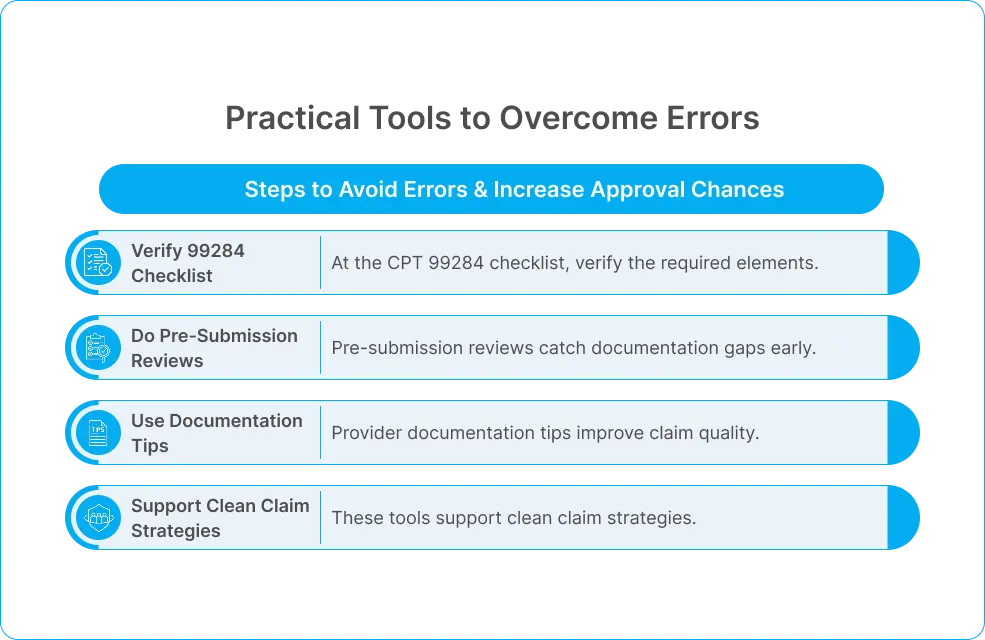
  • Run claims through scrubber + internal audit checklist

Why It’s Important to Code ICD-10 Correctly

There must be a medical reason for doing a biopsy. Just having symptoms may not be enough for the payer to agree.

The ICD-10 code should make it clear why tissue sampling was necessary during the endoscopy.

Common ICD-10 Codes Used with CPT 43239

Common supporting diagnoses consist of GERD, gastritis, gastric ulcers, duodenitis, and inflammatory disorders. People also often use codes for Barrett’s esophagus and possible tumors.

The diagnosis must be consistent with the biopsy justification recorded in the operative note.

Guidelines for Billing CPT 43239

Guidelines for Billing CPT 43239

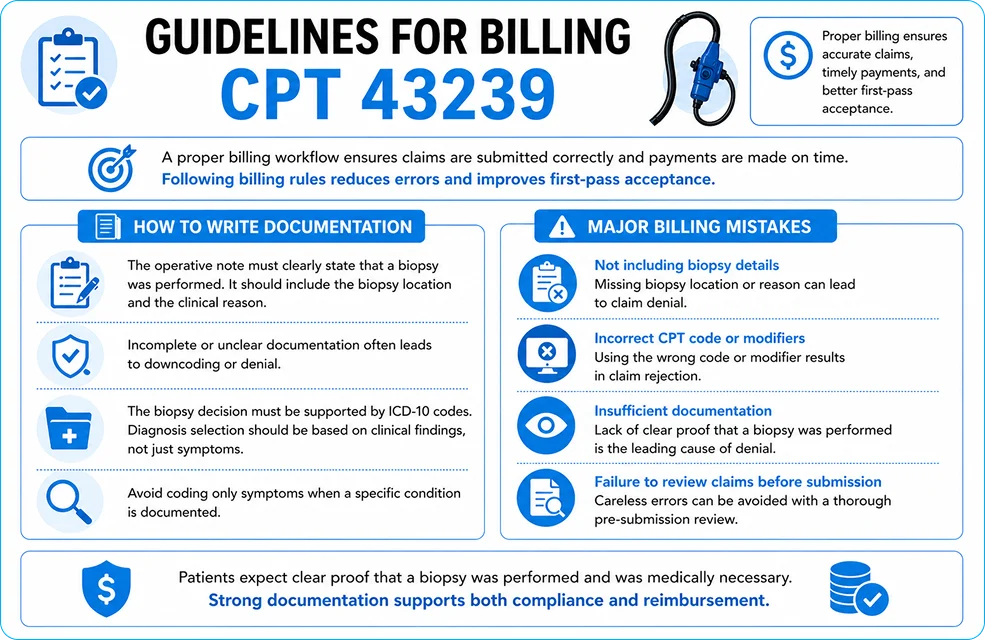
A proper billing workflow makes sure that claims are submitted correctly and payments are made on time. Following billing rules lowers mistakes and makes first-pass acceptance better.

How to Write Documentation

The operative note must make it clear that a biopsy was done. It should say where the tissue sample was taken and why.

Downcoding, or denial, is common when documentation is incomplete or unclear. The biopsy decision must be backed up by ICD-10 codes. The choice of diagnosis should be based on clinical findings, not just symptoms.

When a clear condition is documented, don’t just code the symptoms.

Major Billing Mistakes

Not including biopsy details is a common mistake. Claim failures can also happen when the wrong CPT code and modifier are used.

Before you send it in, make sure to look it over carefully to avoid these problems. The most common reason for denying CPT 43239 claims is a lack of documentation. Patients want to see clear proof that a biopsy was done and was medically necessary. Strong documentation helps with both compliance and getting paid.

What Must Be in an Operative Note

The operative note must say that a biopsy was done. It should say where in the body it is, like the esophagus, stomach, or duodenum.

Clear documentation shows the procedure met CPT requirements.

Biopsy Details That Must Be Included

The number of biopsy samples should be documented. The clinical reason for the biopsy must also be stated.

These details support medical necessity and pathology billing.

Documentation Mistakes to Avoid

Vague procedure notes often result in denials. 

Another common problem is not connecting the results to the biopsy.

The paperwork should make it clear why tissue sampling was necessary.

Modifiers Applicable to CPT 43239

Modifiers help explain special circumstances during billing. Incorrect modifier use is a frequent cause of denials.

Understanding when and how to apply modifiers is essential.

Commonly Used Modifiers

Modifier 51 is used for multiple procedures. Modifier 53 applies to discontinued procedures. Modifier 59 identifies distinct procedural services.

Modifiers XE and XP describe separate encounters or providers.  Use modifier 22 for more procedural services.

How to Pick the Right Modifier

Before using Modifier 59, make sure that the procedures are really different. Find out if a procedure was stopped or not finished.

Don’t use extra modifiers that might make payers look more closely.

Global vs. Split Billing for CPT Code 43239

The rules for billing depend on where the procedure is done. Knowing about these differences helps avoid mistakes in billing.

There are different rules for getting paid back in each environment. Split billing is used by hospital outpatient departments. The doctor and the facility send separate bills. In this case, the rules for Medicare OPPS often apply.

Billing for an Ambulatory Surgery Center (ASC)

ASC billing follows rules for how much each facility can charge. Rates of pay are different in hospitals. For ASC reimbursement to be correct, coding must be correct.

Endoscopy in the Office

Global billing is common for office-based endoscopy. The doctor sends a bill for both professional and technical parts. The documentation must back up the global service.

Effect of Place of Service

Place of service codes have an effect on how much you get paid and what the payer’s rules are. Choosing the wrong POS can cause payments to be late.

Always check to make sure the billing address is correct.

CPT Code 43239 vs Other EGD Codes

Choosing the wrong EGD code can cause audits and denials. Knowing the differences between codes can help you avoid expensive mistakes.

Each code stands for a different level of service.

CPT 43235 – Diagnostic EGD

If there is no biopsy, use CPT 43235. It only covers looking at it with your eyes.

Using CPT 43239 without a biopsy is incorrect.

CPT 43250 / 43251 – Lesion or Polyp Removal

These codes are used for therapeutic procedures. They include the removal of lesions or polyps.

They are not appropriate for biopsy-only procedures.

CPT 43255 – Bleeding Control

CPT 43255 is reported for active hemorrhage control. It involves therapeutic intervention.

This code should not be confused with biopsy services.

Key Differences & Coding Risks

Using the wrong EGD codes raises the risk of an audit. Good documentation helps you choose the right code. Always write code based on the best service you can give. Billing teams can fix problems faster if they know about common mistakes. Reviewing claims ahead of time increases the chances of success.

Common Denial Reasons for CPT 43239

Payers may state that documentation does not support the biopsy. Bundled service denials are also common.

Messages about modifier inconsistency show that there are coding mistakes.

How to Fix Claims That Were Denied

Look over the paperwork to find any holes. Fix the coding mistakes and send the claim again. Moreover, resubmitting on time leads to better reimbursement results.

CPT 43239 is thought to be sensitive to audits. Using it wrong could lead to payer reviews or compliance audits. A lot of people worry about upcoding from diagnostic EGD. Payers keep a close eye on the reasons for biopsies. Clear records lower the risk of an audit.

Missing pathology links are a cause for concern. Using CPT 43239 over and over again without changing it could also get attention. Auditors look for patterns in the way documents are written.

Regular internal audits of documents help find risks. Ongoing coding education helps people follow the rules. Long-term income is protected by internal controls.

Checklist for CPT Code 43239 Before Submission

A final check before sending in your work lowers the number of mistakes. Checklists help make sure that claims are clean.

These steps save time through efficient denial management.

Checking Before Billing

Make sure the biopsy is written down. Make sure that ICD-10 codes support medical necessity.

Verify clinical alignment.

Coding & Modifier Validation

Confirm modifier necessity. Review bundling rules carefully.

Correct errors before submission.

Final Claim Review

Ensure pathology coordination is complete. Run claims through a scrubber.

Submit only clean claims.

Conclusion

CPT Code 43239 is very important for billing in gastroenterology. For compliance, it is important to keep accurate records, use the right diagnosis codes, and use the right modifiers.

Providers can cut down on denials, avoid audits, and get better reimbursement by following best practices. Proactive billing and thorough documentation protect both the quality of patient care and the money coming in.

Frequently Asked Questions (FAQs)

What is CPT code 43239 used for?

It is used for esophagogastroduodenoscopy. CPT code 43239 is used to describe a procedure in which a healthcare provider performs an esophagogastroduodenoscopy (EGD) with biopsy.

What is the difference between CPT 43235 and 43239?

While CPT 43235 is used for diagnostic endoscopies, CPT 43239 covers procedures involving biopsies.

Does 43239 need a modifier?

Yes, but only if each procedure is performed at a separate anatomical site or for a distinct clinical reason. Modifier 59 may be required, and clear documentation must support the separation.

What are D1 and D2 in endoscopy?

D1 indicates the first part of the duodenum, and D2 indicates the second part of the duodenum.


CPT Code 93000 Described: From Documentation to Reimbursement

Accurate CPT coding in healthcare is as important as clinical practices. Coding mistakes lead to reduced reimbursements and compliance risks. Claim denials often happen due to billing errors, improper coding, and missing modifiers. CMS (Centers for Medicare & Medicaid Services) data shows that Medicare paid $31.7 billion in wrong payments in 2024. This shows how expensive it can be to code incorrectly.

Proper coding helps healthcare providers increase reimbursement and prevent claim denials. Cardiology offices lose money in billing and audit failures. Missing documentation or an incorrect modifier can trigger audits, fines, and claim denials. This blog explains how to prevent common billing and coding mistakes.

For billing in cardiology, CPT Code 93000 is very important. Doctors often use it to do electrocardiograms (ECGs/EKGs), which evaluate the heart’s rhythm and electrical activity. People often confuse CPT 93000, CPT 93005, and CPT 93010. These codes stand for different parts of a service. This blog explains how to prevent common billing and coding issues.

What Is CPT Code 93000?

A full electrocardiogram procedure is what CPT Code 93000 means. It includes a standard 12-lead ECG, which records the heart’s electrical activity, a doctor’s interpretation, and a formal report. This diagnostic tool gives you information that can help you figure out how healthy your heart is and find heart problems like arrhythmias.

Clinical and Billing Context of CPT Code 93000

CPT code 93000’s global service includes technical and professional services. The technical side includes how to place ECG leads, how to get a tracing, and how to use the equipment. A qualified doctor interpreting the results and writing a report is part of the professional side. 

According to CMS (Centers for Medicare & Medicaid Services), global billing services are applicable for technical and professional services provided by the same organization, so modifiers 26 and TC are not required.

CPT Code for EKG in Office

Electrocardiogram (EKG/ECG) services performed inside a physician’s office are billed using specific CPT codes based on how the test is provided and interpreted.

Common office-based EKG CPT codes include:

CPT CodeDescriptionBilling Scenario
93000Complete EKG with tracing, interpretation, and reportPhysician performs and interprets the EKG in-office
93005Tracing only, without interpretationOffice performs test but another provider interprets it
93010Interpretation and report onlyProvider interprets externally performed EKG

An EKG is commonly ordered to evaluate:

  • Chest pain
  • Arrhythmias
  • Shortness of breath
  • Hypertension-related cardiac changes
  • Pre-operative cardiovascular assessment

Accurate EKG billing depends on proper documentation of:

  • Medical necessity
  • Physician interpretation report
  • Symptom or diagnosis linkage through ICD-10-CM codes
  • Time and date of service

Incorrect modifier usage, missing interpretation reports, or unsupported diagnosis codes frequently trigger payer denials for office-based EKG claims.

ECG CPT Codes 93000 Series

The ECG CPT Codes 93000 series encompasses a range of codes used to document various types of electrocardiogram (ECG) procedures, which assess the electrical activity of the heart. These codes are crucial for billing and insurance reimbursement purposes, and they categorize ECG procedures based on complexity, type, and method of performance.

CPT Code 93016 – Electrocardiogram, Telemetry (Continuous Monitoring)

Used for continuous ECG monitoring, often in hospital settings, this code applies when patients are being monitored in real-time, either in an inpatient or outpatient setting, for extended periods. Telemetry allows for immediate analysis and intervention if abnormalities occur.

CPT Code 93000 – Electrocardiogram, Routine (12-lead)

This is the most common ECG procedure, involving a 12-lead electrocardiogram used for routine diagnostic purposes. It includes the application of electrodes, recording, and interpretation by a physician. It’s typically used to evaluate heart rhythm, rate, and other electrical activity.

CPT Code 93005 – Electrocardiogram, with Interpretation and Report

This code is used when an ECG is performed and the results are interpreted by a healthcare provider. It combines the act of recording the electrocardiogram with a professional interpretation and a written report of findings, making it a more detailed service than the basic 93000.

CPT Code 93010 – Electrocardiogram, with Exercise (Treadmill, Bicycle)

This code refers to an ECG performed during exercise, typically to diagnose heart conditions under physical stress. It is often used in cardiac stress tests to monitor the heart’s response to exercise. It requires additional equipment like a treadmill or stationary bike, and it may require specific clinical documentation to justify the stress component.

CPT Code 93015 – Electrocardiogram, Ambulatory (Holter Monitoring, 24 hours or more)

Holter monitoring provides continuous ECG monitoring over 24 hours or more to capture any abnormal heart rhythms that might not appear during a standard ECG. This extended period allows for the detection of intermittent arrhythmias or transient issues that are not captured in a single ECG.

CPT 93000 is billed when the complete service is provided by a single organization. Billing depends on who performed the test and who interpreted it. These component-based billing situations are very common in cardiology medical billing services where ECG tracing and interpretation are performed at different locations.

CPT 93000 applies if the same provider does both. If different providers do each part, use CPT 93005 and CPT 93010 to split the services and follow payer rules.

ECG CPT codes vary depending on which portion of the service is performed. Clinics often report CPT 93005 when they send the tracing to another provider for interpretation.

Global vs Split Billing for CPT Code 93000 (26 vs TC Explained) 

Global vs Split Billing for CPT Code 93000

Global Billing

Reporting CPT 93000 globally indicates that both the technical and professional components of the ECG service were completed by the same provider. In this case, a single claim is submitted, covering the entire ECG service.

  • One claim pays for the whole ECG service.
  • Common in: Doctor offices performing on-site ECGs.

Split Billing

Split billing is used when the technical and professional components are billed separately. Modifier TC applies for the technical portion, which includes tracing, equipment use, and staff time. Modifier 26 applies when only the professional interpretation is billed.

  • Modifier TC used for technical component billing.
  • Modifier 26 used for professional interpretation billing.
  • Common in: Outpatient departments, IDTFs with external tracings, and separate physician interpretations.

Key Takeaways

1. Global Billing: One claim for both components (technical + professional).
2. Split Billing: Separate claims for the technical (modifier TC) and professional (modifier 26) components.
Split billing is more common in hospitals, IDTFs, and outpatient settings.

Reporting CPT 93000 globally indicates that the same provider completed both the technical and professional components. In this case, one claim pays for the whole ECG service.

Modifier TC applies when only the technical part is given. This includes tracing, using equipment, and staff time, and it usually matches CPT 93005. When only the professional interpretation is provided, modifier 26 is appended to report the physician’s interpretation separately, typically with CPT 93010.

CPT 93000 is common in doctor offices that do ECGs on-site. Split billing happens more often in outpatient departments of hospitals. IDTFs frequently conduct tracings externally, with interpretation billed separately by physicians.

Clinical Situations for CPT 93000

Clinical Situations for CPT 93000

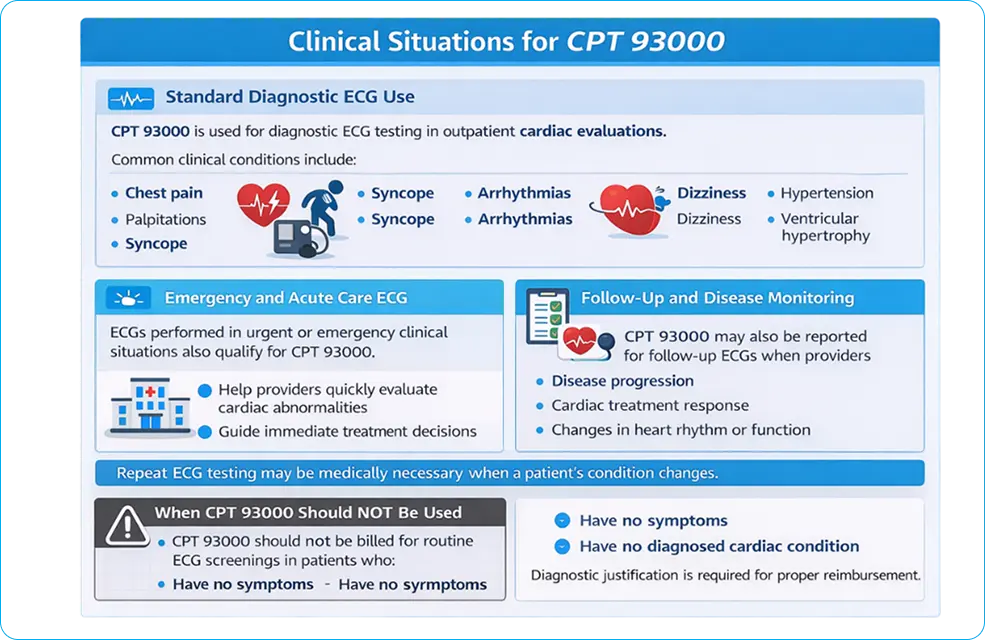
CPT 93000 is the right code for standard diagnostic ECGs that are done in an outpatient setting and for heart evaluations. It supports assessments for chest pain, palpitations, syncope, arrhythmias, dizziness, hypertension, and ventricular hypertrophy. 

Emergency ECGs in acute care settings and follow-up ECGs to track the progress of a disease or the effects of treatment also count. When things change, it may be medically necessary to do ECGs again.

You shouldn’t bill the 93000 code for routine screenings of patients who do not have any symptoms or diagnosed heart problems.

How the Place of Service (POS) Affects CPT 93000 Billing 

Where the service takes place affects the bill. POS 11 is for doctors’ offices and ECGs done on an outpatient basis. POS 19 and POS 22 are for hospital outpatient departments, and they have different rules for billing outpatients. POS 21 stands for inpatient services, which often include ECGs.

Choosing the wrong POS can result in stuck ECG claims, denied payment, and lower reimbursement. Many practices face repeated POS related claim denials that require dedicated denial review and correction.

Does 93000 CPT Code Need a Modifier?

Yes! In specific conditions cpt code 93000 requires a modifier to explain the case effectively. Modifier 26, modifier TC, modifier 59, modifier 76, modifier 77, and modifier 91 are some of the most common ones. These modifiers make it clear who is responsible for each part and stop duplication.

CMS and AMA CPT guidelines require appropriate modifier use to prevent overlapping claims. There must be a medical reason for repeat ECGs. It is essential to keep clear records of same-day ECGs, changes in condition, and serial ECGs.

Strong documentation includes patient identifiers, signed interpretation reports, clinical notes, and a clear reason for the ECG to show that it was medically necessary.

ICD-10 Diagnosis Codes to Pair with CPT 93000

Payers require the symptoms that are reported to match the diagnoses that are confirmed. Heart problems like arrhythmias, coronary artery disease, heart block, pulmonary embolism, sinus tachycardia, and ST-T changes are reasons to get an ECG.

A common reason for claim denials is a mismatch in diagnosis. Medical necessity logic has to link symptoms, doctor’s orders, and ICD-10 codes.

Medicare and Payer Reimbursement for CPT 93000

The Medicare Physician Fee Schedule (MPFS) pays for CPT 93000 depending on where you live and what your contract says.

Medicare Advantage plans may have different rules for getting approval for each plan than traditional Medicare. Risks of underpayment include missing component billing and contractual allowances.

CMS frequency limits, Local Coverage Determinations (LCDs), and National Coverage Determinations (NCDs) make it hard to bill for ECGs more than once. Screening ECG limits only apply to patients who do not have any symptoms.

Best Practices for Billing CPT 93000

Providers may report CPT 93000 with E/M services such as 99214 using modifier 25 when the services are separately identifiable and medically necessary. Cardiac stress tests (CPT 93015–93018) include ECG monitoring, while Holter monitoring (CPT 93224–93227) and pacemaker evaluations (CPT 93279–93298) may be reported separately with modifier 59 when appropriate.
Avoid bundling or unbundling mistakes under the National Correct Coding Initiative (NCCI). Use internal workflow checklists to review the claims, modifiers, and documentation prior to submitting a claim.

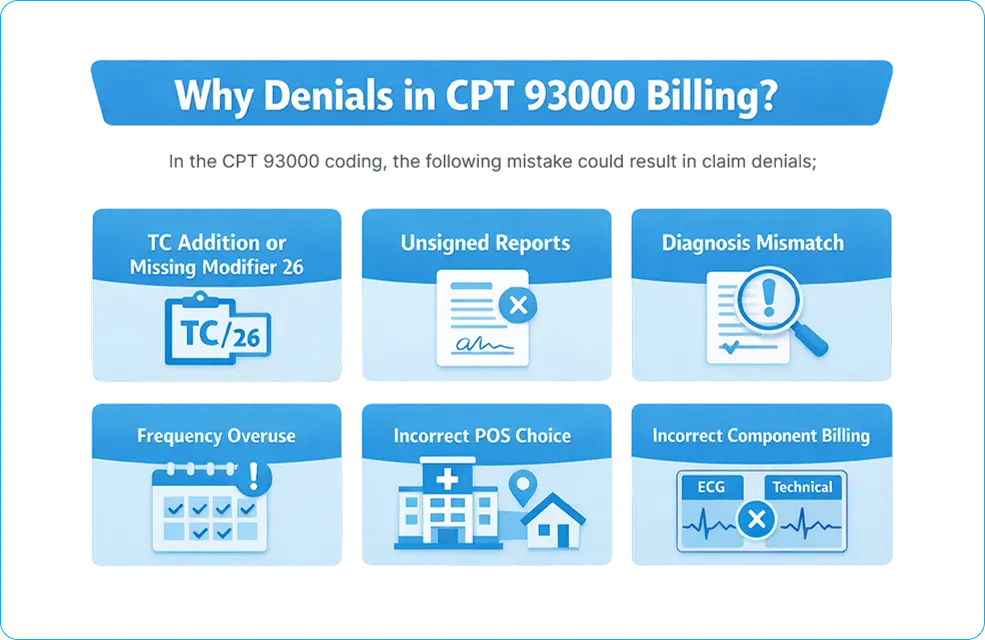
Why Denials in CPT 93000 Billing

Why Denials in CPT 93000 Billing

In documentation and billing pf 93000 CPT code, the following mistakes could result in claim denials:

  • TC addition or missing modifier 26
  • Reports on unsigned interpretations
  • Mismatch in diagnosis
  • Overuse exceeding frequency thresholds
  • Incorrect POS choice
  • Incorrect component billing 

Risks of Audit and Compliance

High-frequency ECG billing increases the likelihood of audits. Incomplete records and improper modifier use frequently trigger duplication flags. CMS and OIG audits often uncover unsigned or inaccurate documentation.

To remain compliant, you must be truthful, maintain correct records, and abide by AMA CPT regulations.

Conclusion

For accurate cardiology billing and prompt payment, CPT Code 93000 is essential. Understanding the difference between global and split billing, applying the correct modifiers, and selecting the proper place of service significantly reduces the risk of claim denials.

You can avoid frequent audits and underpayments by following CMS, LCD, and NCD regulations. Small errors, such as unsigned reports or missing modifiers, can lead to numerous billing issues. Preventing these recurring issues often requires expert support in ECG claim denial recovery and billing workflow improvement. By adhering to NCCI principles and best practices, healthcare practices may protect their funds and steer clear of audits. Correctly billing for CPT 93000 involves more than just receiving payment. Maintaining compliance is also another aspect of it.

FAQs:

Can you bill CPT 93000 along with an E/M service?

 Yes, when it’s medically necessary and different, use modifier 25.

When is it better to use 93000 instead of 93005 or 93010?

 If the same provider does both tracing and interpretation, use CPT 93000.

What papers do you need for CPT 93000?

 A clinical history, a doctor’s order, an interpretation report, and an ICD-10 diagnosis.

Do the same rules apply to Medicare Advantage?

Not always. Medicare Advantage plans have rules and documentation requirements that are specific to each payer.


© 2026, Avanue Billing Service, Design & Developed By BitBlazeTec